Real Estate Executive Search: How Firms Find Top Leadership Talent

Need to hire a new executive? Good luck finding the right one through a job post.
The leaders most real estate firms want aren’t refreshing LinkedIn, looking for their next opportunity. They’re busy leading another company, growing a portfolio, raising capital, or closing deals.
And even if they were looking, a resume would only tell you part of the story.
Hiring at this level takes more than filling an opening. And, in real estate, it follows a very different process.
Next, you’ll see how real estate executive search works, which roles benefit the most, and how to choose a partner that can help you find the right leader before someone else does.
Let’s begin.
TL;DR
Running short on time? These are the ideas worth remembering.
- Executive search in real estate is built for leadership hires, not everyday recruiting.
- The best executives rarely apply through job boards. Finding them takes a proactive search.
- Roles in the C-suite, investments, development, asset management, and operations usually benefit the most from executive search.
- Industry expertise matters. Great leaders from another sector don’t always translate into great real estate leaders.
- A successful search starts long before a position becomes vacant.
- The right executive can influence your company’s growth, investor confidence, and long-term performance for years.
What Exactly Is Real Estate Executive Search?
Executive search in real estate is a specialized recruitment process for hiring senior leaders.
Instead of waiting for executives to apply, recruiters actively identify, approach, and evaluate people who already have the experience your business needs. Simple enough.
The tricky part is finding those people in the first place.
The leaders you’re hoping to hire usually aren’t looking for a new job. They’re busy leading another company, managing investments, or closing deals.
And that’s only the first difference from a standard hiring process.
What makes executive search different from traditional recruiting?
At first glance, both processes look pretty similar. You have a role to fill, candidates need to be evaluated, interviews happen, and an offer goes out.
The similarities end there.
Traditional recruiting usually works best for positions where companies can rely on active applicants.
Meanwhile, executive search in the real estate industry starts much earlier. It focuses on identifying leaders, reaching out to them directly, and evaluating whether they’re the right fit before they ever submit an application.
Here’s a quick comparison:
| Traditional Recruiting | Executive Search |
| Focuses on active job seekers. | Proactively reaches experienced executives. |
| Common for mid-level and operational roles. | Built for senior leadership positions. |
| Prioritizes speed. | Prioritizes long-term fit. |
| Relies heavily on incoming applications. | Combines market research, direct outreach, and leadership assessment. |
Which real estate leadership roles usually call for executive search?
Not every hire needs this level of attention. Some roles simply carry too much responsibility to leave things to chance.
In real estate, executive search is commonly used for positions like:
- CEO.
- COO.
- CFO.
- Chief Investment Officer.
- Managing Director.
- Head of Acquisitions.
- Head of Development.
- Vice President of Asset Management.
- Regional Operations Executive.
- Senior Property Management Executive.
One decision from any of these leaders can affect investments, operations, hiring, and long-term business strategy. That’s why finding the right person matters long after the onboarding process ends.
Why specialization matters in real estate
A great executive on paper isn’t always the right executive for your business.
Real estate has its own pace, challenges, and way of making decisions.
Managing a multifamily portfolio isn’t the same as leading a retail company. Running a commercial real estate investment platform isn’t the same as overseeing another financial business.
A recruiter who specializes in executive search in real estate understands those differences. They know what success looks like in different sectors, which backgrounds translate well, and which ones don’t.
That saves everyone a lot of time and helps companies avoid expensive hiring mistakes.

Why Do Real Estate Companies Turn to Executive Search Instead of Hiring on Their Own?
Leadership hires come with a different set of challenges. That’s why many companies choose executive search in real estate when the stakes are high.
Here’s what usually pushes them in that direction:
- Access to leaders who aren’t actively job hunting. The strongest candidates are usually busy leading another business, not applying for new roles.
- Industry expertise that goes beyond resumes. Leadership, deal experience, and market knowledge don’t always fit on a one-page CV.
- A confidential hiring process. Replacing a senior executive or planning for succession isn’t something every company wants to announce publicly.
- Stronger alignment with long-term business goals. Executive hires shape strategy for years, not just the next quarter.
The industry is moving in the same direction.
Recent research shows why more companies are treating executive hiring as a long-term business decision:
- A 2025 study by NAIOP points out that leadership transitions in commercial real estate are rarely simple. Ownership structures, investor relationships, and years of market knowledge all make succession planning a much bigger job.
- Ferguson Partners’ 2026 Governance Survey found that 35% of commercial real estate board members ranked succession planning as their top human capital priority.
- Per recent research, 9 out of 10 executives and senior leaders are open to hearing about new roles. Waiting for them to apply isn’t much of a strategy.
It all points in the same direction. Planning ahead gives companies more options and a better chance of making the right hire.
Which Real Estate Leadership Roles Are the Hardest to Fill?
Some positions simply leave less room for error. In the real estate industry, executive search usually focuses on roles where leadership, market knowledge, and business judgment carry just as much weight as technical experience.
The list usually includes:
- C-suite executives. CEOs, COOs, CFOs, and Chief Investment Officers set the direction of the business. One decision can influence investments, operations, hiring, and long-term growth.
- Investment and acquisitions leaders. Finding opportunities is only part of the job. These leaders also decide which deals deserve your capital and which ones don’t.
- Asset and portfolio management executives. Growing a portfolio takes much more than buying properties. Strong leaders know how to improve performance while balancing investor expectations and long-term value.
- Development and construction leadership. Delays, budgets, permits, contractors, timelines. These executives keep every moving piece working together while projects move forward.
- Property management and operations executives. Larger portfolios create larger operational challenges. The right leader keeps teams aligned, tenants satisfied, and day-to-day operations under control.
- Capital markets and finance leaders. Raising capital, managing lender relationships, and supporting future growth all depend on experienced financial leadership.
The higher the role, the smaller the margin for error. That’s exactly why companies take a different approach when hiring for these positions.
Here’s What an Executive Search Actually Looks Like in Real Estate
Executive search can feel like a black box if you’ve never worked with a recruiting firm before.
However, every step of the process has a purpose:
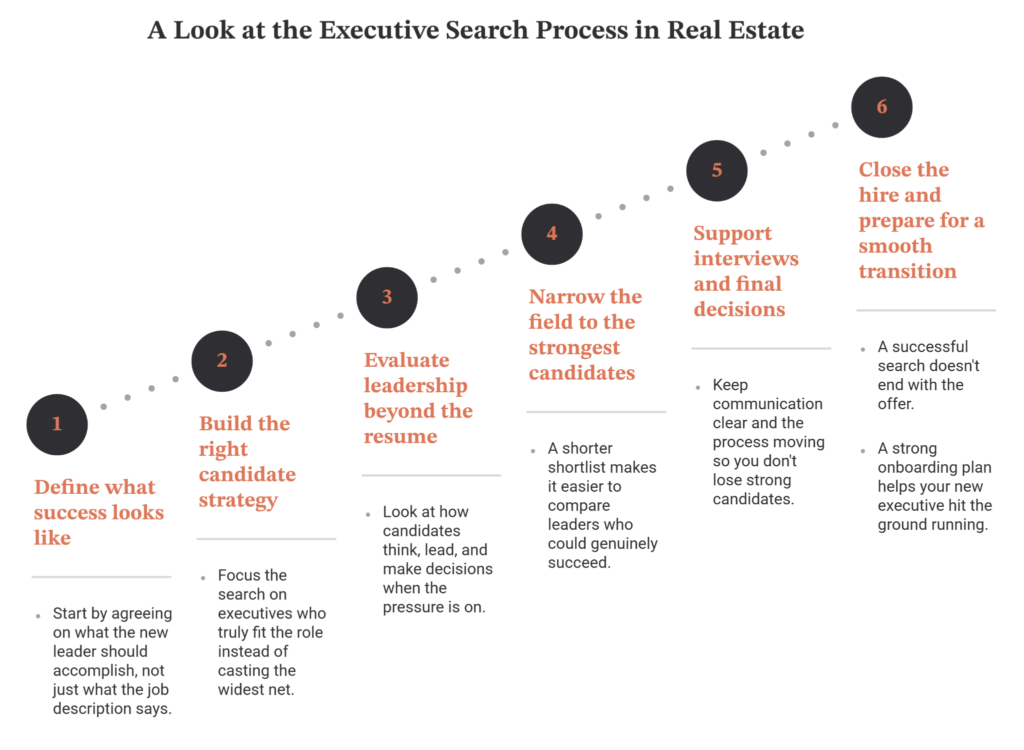
Define what success looks like
The search starts long before anyone is contacted.
First, you need to answer a simple question: What should this person accomplish during their first year?
That answer shapes everything else, from the type of companies recruiters target to the leadership qualities they prioritize.
Build the right candidate strategy
Now the search begins. Recruiters identify companies where strong candidates are already working, map the market, and start confidential outreach.
The goal here is clear: to approach the right executives.
Evaluate leadership beyond the resume
A polished resume gets someone’s attention. It doesn’t explain how they lead a team, make difficult decisions, or respond when things don’t go according to plan.
Those conversations happen during the search, not after the offer.
Narrow the field to the strongest candidates
More candidates don’t always mean better choices. A shortlist works best when every person on it could realistically succeed in the role.
That lets your team spend less time comparing resumes and more time having meaningful conversations.
Support interviews and final decisions
This is where small details start making a difference. Interview coordination, candidate feedback, compensation discussions, and expectation setting all help keep the process moving.
Without that structure, even strong candidates can lose interest.
Close the hire and prepare for a smooth transition
Getting a signed offer feels great, but keeping the momentum going matters just as much.
Planning the transition, preparing onboarding, and helping the new executive settle into the role all increase the chances of a successful hire.
What Separates a Good Real Estate Executive From the Right One?
Two executives can walk into the interview with nearly identical resumes. Similar experience, strong track records, and leadership roles at respected companies.
Then one joins your business, and everything starts moving in the right direction. The other never quite finds its place.
That happens more than you’d think.
The difference usually comes down to qualities that are much harder to measure before someone walks through the door.
Here’s what companies pay close attention to before making a final decision:
- Strategic thinking. The best leaders don’t spend every week reacting to problems. They see what’s coming, make decisions early, and keep the business moving forward.
- Financial and investment expertise. Growth means very little if the numbers don’t support it. Strong executives know how to balance opportunity, risk, and long-term value.
- Leadership people want to follow. A job title can earn authority. Trust takes something else. The right executive knows how to bring people together around a common goal.
- Deep real estate market knowledge. Every sector comes with different challenges. Leading a multifamily portfolio isn’t the same as leading a commercial real estate investment firm or a property management company.
- The ability to lead through market cycles. Markets change. Investment priorities shift. Good leaders stay focused and help everyone else do the same.
Technical skills help someone qualify for the role. But the qualities above usually decide who becomes the right hire.
How Can You Tell You’ve Found the Right Real Estate Executive Search Partner?
Every recruiting firm says it can find great candidates. That’s expected.
The better question is if they can find the right executive for your business.
Here’s what separates the firms that real estate companies keep coming back to.
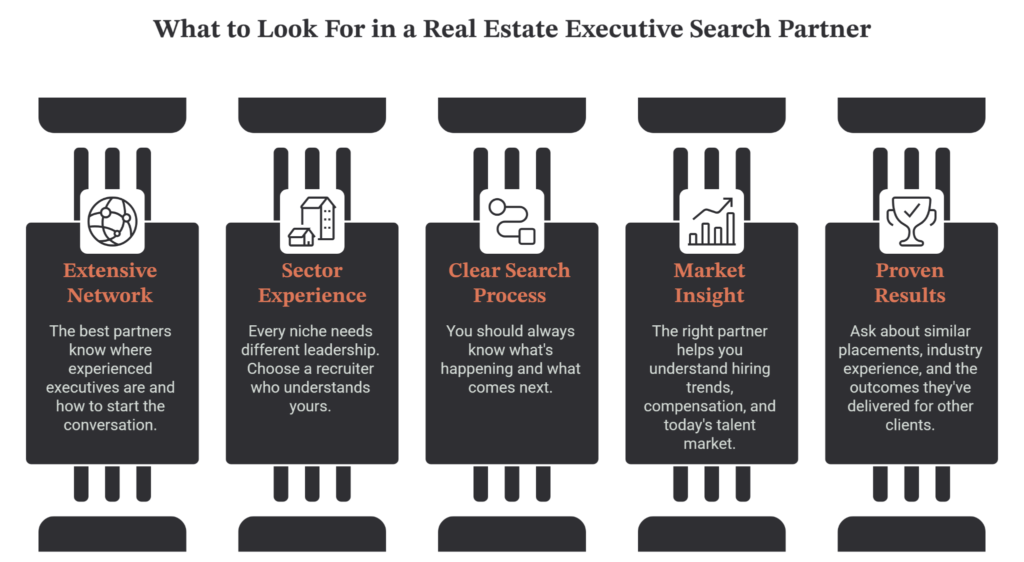
A network that reaches the right people
The executives you’re hoping to hire probably aren’t applying for jobs every week.
A strong search partner already knows where those leaders are and has the relationships to start conversations that most companies can’t.
Real experience across the real estate sector
Real estate isn’t one market. Development, commercial real estate, multifamily, asset management, and property management all need different types of leadership.
Working with a recruiter who understands those differences makes the search much more focused from the start.
A search process that’s clear from day one
You shouldn’t have to chase updates or wonder what happens next.
A good search partner explains the process upfront, keeps communication consistent, and makes sure everyone knows where the search stands.
Market insight that adds value
Strong recruiters don’t just introduce candidates.
They also help you understand compensation expectations, hiring trends, talent availability, and the challenges that could affect your search before they become obstacles.
Results that speak for themselves
Every firm has success stories. The important question is if those stories look anything like yours.
Ask about leadership roles they’ve filled, the sectors they know best, and the results they’ve helped clients achieve. Their answers will usually tell you far more than a polished sales presentation.
What Can Slow Down a Real Estate Executive Search?
Need to hire a senior leader fast? That’s completely fair; nobody wants a key position sitting empty for months.
The problem is that the biggest delays usually don’t come from finding candidates. They happen somewhere else.
Here are the issues that slow companies down the most:
- An unclear leadership profile. If nobody agrees on what the business really needs, recruiters end up searching for a moving target.
- Expectations that don’t match the market. Looking for the perfect executive while offering a package that doesn’t match the role usually makes the candidate pool much smaller.
- Slow decision-making. Great candidates don’t stay available forever. A week of silence can be enough for another company to make an offer first.
- Putting culture in the background. Skills matter. Experience matters. If the new executive doesn’t fit the leadership team, problems usually appear sooner rather than later.
- Losing momentum during the process. Long interview rounds, unclear communication, or changing priorities make it much easier for strong candidates to walk away.
None of this is unusual.
In fact, another report by Ferguson Partners found that 92% of firms have a well-established hiring and onboarding strategy, but only about half have a similarly developed workforce planning strategy. The gap is even bigger among smaller firms.
The takeaway is pretty simple:
Companies that start thinking about leadership after someone leaves usually have fewer options. But the ones planning ahead have far more room to make the right decision.
How Long Should You Expect a Real Estate Executive Search to Take?
Everyone asks this sooner or later: “How long is this going to take?”
Well, hiring a senior executive isn’t the kind of decision you want to rush. This person could influence your business for years, so taking a little more time up front usually saves a lot of problems later.
A few things have the biggest impact on the timeline:
- A well-defined role. Recruiters can move much faster when everyone agrees on what success looks like from the beginning.
- Fast decisions from your team. Candidates notice when a process keeps moving. They also notice when communication suddenly stops.
- The talent available in your market. Some leadership roles naturally have a much smaller pool of qualified candidates, especially in commercial real estate, capital markets, or asset management.
One last thing.
Your recruiting partner isn’t the only one keeping the search moving. Quick feedback, clear communication, and timely decisions from your team make a huge difference.
How Can the Right Real Estate Executive Shape Your Company’s Future?
A leadership hire doesn’t end on day one. That’s when the real work starts.
The right executive can influence your business for years. Meanwhile, a poor hire rarely stays an isolated problem. It spreads into operations, company culture, and long-term growth.
Here’s what the right executive can bring to the table:
- Stronger business performance across the portfolio. Better decisions usually lead to healthier assets, smoother operations, and stronger financial results over time.
- Better leadership for growth and expansion. Opening a new market, growing a portfolio, or leading a major acquisition becomes much easier when someone has done it before.
- More confidence from investors and stakeholders. Strong leadership sends a clear message. The business has a plan, and the people leading it know where they’re going.
- A competitive edge through strong leadership. Markets change all the time. Companies with experienced leaders usually adapt much faster than those still trying to figure out their next move.
One executive won’t solve every challenge your business faces. But the right one can make every challenge a little easier to solve.
In Real Estate, Great Leadership Hires Rarely Happen by Chance
As you can see, hiring a senior executive is one of the biggest decisions a real estate company can make.
Get it right, and you’ll have someone who can help your business grow, guide your team through change, and make better decisions when the pressure is on.
If you’re preparing for your next leadership hire, working with the right partner can make the entire process a lot easier. At Estate Skyline, that’s exactly what we help real estate firms do every day.
If you’d like to talk through your next executive search, let’s talk. We’d be happy to help.
FAQs
What is a real estate executive search, and how does it work?
Think of it as hiring for the roles that have the biggest impact on your business. A search firm goes out, finds executives who fit what you’re looking for, and helps you compare them before anyone signs an offer.
Instead of waiting for the right person to apply, you’re going after them.
Why is executive search important in the real estate industry?
Because one leadership hire can change a lot. The right executive helps your business grow. But the wrong one can slow projects, affect your team, and leave you hiring for the same role again sooner than you’d like.
How can a real estate executive search firm help companies hire top executives?
The biggest advantage? Access.
Search firms spend their time talking to leaders who probably aren’t applying for jobs. That gives you a much better chance of meeting candidates you wouldn’t find through a regular job post.
How does executive recruitment differ from general hiring in real estate?
Most hiring starts after someone submits an application. Executive search works the other way around. Recruiters identify the right people first, then start the conversation from there.
When should a real estate company use an executive search firm instead of internal recruiting?
If the role could shape the future of your business, it’s probably worth it. Hiring a CEO, planning for succession, or building a new leadership team are all situations where executive search can give you a real advantage.


- TL;DR
- What Exactly Is Real Estate Executive Search?
- Which real estate leadership roles usually call for executive search?
- Why Do Real Estate Companies Turn to Executive Search Instead of Hiring on Their Own?
- Which Real Estate Leadership Roles Are the Hardest to Fill?
- Here's What an Executive Search Actually Looks Like in Real Estate
- What Separates a Good Real Estate Executive From the Right One?
- How Can You Tell You've Found the Right Real Estate Executive Search Partner?
- What Can Slow Down a Real Estate Executive Search?
- How Long Should You Expect a Real Estate Executive Search to Take?
- How Can the Right Real Estate Executive Shape Your Company's Future?
- In Real Estate, Great Leadership Hires Rarely Happen by Chance
- FAQs