Which Property Management Jobs are Most In-Demand in 2026?

A career in real estate can take you in a lot of different directions. And property management is one of them.
You might end up leading a property team, working with residents every day, running leasing operations, or keeping entire communities running behind the scenes.
The tricky part is that job titles don’t always tell the full story. Two openings can look almost identical. Then you read the description and realize the day-to-day work is completely different.
For that reason, a little research before you apply can make it much easier to compare your options and make your next career move with confidence.
Next, you’ll learn which property management jobs employers are hiring for in 2026, what each role actually involves, and what to look for as you decide where to apply.
Let’s take a look.
TL;DR
If you’re thinking about a career in property management, keep these points in mind:
- Property management offers several paths, from leasing and maintenance to operations and leadership.
- The strongest hiring demand in 2026 continues to center around property managers, maintenance technicians, leasing professionals, and maintenance supervisors.
- Every role requires a different mix of technical knowledge, communication skills, and day-to-day responsibilities.
- Looking beyond the job title makes it much easier to find a position that fits your strengths and long-term goals.
- Employers value practical skills just as much as industry experience, especially communication, customer service, and regulatory knowledge.
- A little research before applying can help you build a stronger career, not just land your next job.
Here’s What the Property Management Job Market Looks Like in 2026
One thing hasn’t changed: good property management teams are hard to build.
Properties don’t run themselves. Someone has to keep residents happy, coordinate maintenance, solve problems, stay on top of leases, and make sure the whole operation keeps moving.
As more properties come under management, companies need more people who can do that work well.
You can see it in the latest numbers.
- The U.S. Bureau of Labor Statistics expects about 39,000 openings each year for property, real estate, and community association managers through 2034. A big part of that comes from experienced professionals leaving the workforce.
- Industry research by Buildium found that 75% of property managers plan to grow during 2026. Only 55% expanded during 2025.
- AppFolio’s benchmark survey found that 81% of property management professionals feel positive about 2026, while 77% expect to increase the number of units they manage.
So yes, companies are hiring. They’re also looking for different kinds of professionals.
Meet the Property Management Jobs That Are in High Demand Right Now
Not every property management job leads to the same career.
Some roles help you build leadership skills. Others give you hands-on experience or put you in front of residents every day. Knowing where companies are hiring can help you choose a path that fits what you want, not just the first opening you come across.
The latest data about job demand comes from a Q2 2025 report by the National Apartment Association (NAA). It focuses on the U.S. multifamily and apartment sector, so it doesn’t cover every corner of property management.
Still, it gives a good picture of the roles employers are looking for the most:
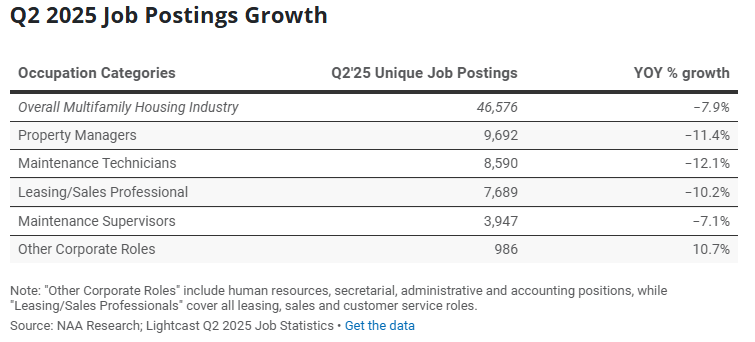
Source: National Apartment Association
As you can see, the year-over-year numbers are down for several positions.
But that doesn’t change the bigger picture.
Thousands of openings in a single quarter still tell you companies need people to manage properties, support residents, and keep operations moving. The question is which one makes the most sense for you.
Let’s look at the biggest ones.
Property Managers
This is the role most people think of first, and it usually offers more variety than they expect.
As a property manager, you’ll spend part of your day talking with residents. Then you’ll switch to budgets, lease renewals, vendor meetings, or helping your team solve a problem before it grows into something bigger.
You’re constantly moving from one priority to the next.
If that sounds exhausting, this probably isn’t the right fit. But if you don’t mind solving different problems every day and keeping people on the same page, you’ll probably enjoy it.
Maintenance Technicians
Walk through any apartment community, and you’ll see how much it depends on the maintenance team.
A leaking pipe, an AC unit that stops working, or even a broken gate. None of those problems stays small for very long. That’s one reason this role stays in demand.
Buildium’s research also found that 56% of rental owners say maintenance support is one of the biggest reasons they hire a property manager.
That says a lot.
Maintenance technicians aren’t just fixing things. They’re helping properties run smoothly, keeping residents happy, and preventing small repairs from turning into expensive ones.
A typical day might include:
- Responding to maintenance requests.
- Troubleshooting plumbing, electrical, or HVAC issues.
- Completing preventive maintenance.
- Coordinating with outside vendors.
- Helping keep the property safe and in good condition.
If you like solving problems and seeing the results of your work right away, this career can be a great fit.
Leasing and Sales Professionals
Every signed lease starts the same way. Someone has a question, and you’re usually the person answering it.
That means your job isn’t just giving tours or explaining lease terms. Actually, you’re helping people decide where they’re going to live. Clear communication, good follow-up, and the ability to build trust matter just as much as your sales skills.
Do that well, and you’ll build experience that’s useful far beyond leasing. Many property managers started their careers in exactly this role.
Maintenance Supervisors
At some point, fixing problems isn’t your biggest responsibility anymore.
Helping other people fix them is.
Maintenance supervisors spend less time holding tools and more time planning schedules, assigning work, checking quality, and ensuring nothing falls through the cracks.
Experience still matters. Now you’re also expected to lead a team, make decisions, and keep everyone moving in the same direction.
It’s a natural next step for technicians who want to grow without leaving the maintenance side of the business.

How to Find the Property Management Path That Fits You
Getting a job is one thing. But still enjoying it a couple of years from now is something else.
It’s easy to focus on the salary or the company name. The work itself deserves just as much attention. A role that matches the way you like to work usually leads to better opportunities over time.
Here’s where we’d start:
Match the Role to Your Experience Level
You don’t need to become a property manager on day one.
In fact, many people don’t.
Leasing, maintenance, and assistant roles teach you how properties operate from the ground up. You’ll see how teams work together, how resident issues get resolved, and what keeps a property running smoothly.
That experience adds up. When a management opportunity opens later, you’ll already understand how the day-to-day work fits together.
Choose the Property Type That Suits You
Not every property feels the same.
Managing a large apartment community is very different from working in commercial real estate, student housing, or senior living.
Think about the kind of workday you want: Would you rather spend more time working with residents? Leading a team? Coordinating maintenance?
The answer usually points you toward the right type of property long before you send your first application.
Think About How You Like to Work
Some people enjoy fast-paced days where no two problems are the same. Others prefer more structure, clear processes, and planning ahead.
Neither approach is better, and property management has room for both.
A large apartment community, a commercial property, or a regional management role can all feel very different, even if the job title is similar. Thinking about the kind of work environment you enjoy can help you narrow your search and compare opportunities with a little more confidence.
Key Insight: Property management careers don’t all lead to the same type of employer. As the BLS also reports, 52% of property, real estate, and community association managers work in the real estate industry, while 34% are self-employed. So, looking beyond one type of employer may open more opportunities than you expect.
How to Know What Employers Will Look For
Landing a property management job is about showing employers you already have the skills that matter and a plan to build the ones you don’t.
That’s good news if you’re coming from another industry. A lot of what property management companies look for can be learned on the job. Other skills might already be part of your day-to-day work.
Let’s start there:
Start with the skills you already have
A surprising number of people already have experience that carries over into property management.
Think about jobs where you’ve worked with customers, handled difficult conversations, stayed organized under pressure, or kept several priorities moving at the same time.
Those are all valuable here.
Maybe your last job wasn’t in real estate. That doesn’t automatically put you behind.
Employers want people who can solve problems, communicate well, and work with others. If you’ve done that before, make it easy to see on your résumé.
Add the Skills That Matter Most
Transferable skills can help you get your foot in the door.
Building industry-specific skills helps you move forward.
In their Q2 2025 report, the NAA found that employers consistently look for a handful of skills across different property management roles. Communication, customer service, industry knowledge, initiative, leadership, and regulatory compliance were some of the most requested.
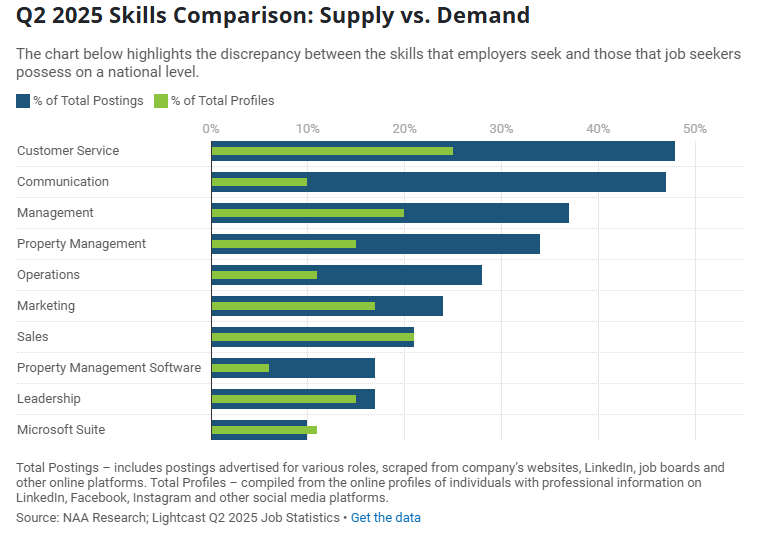
Source: National Apartment Association
There’s a pattern here.
Those skills go hand in hand. You might know property management inside and out, but you’ll still spend a big part of your day talking with residents, coordinating with vendors, and helping your team solve problems.
That’s why employers look for a mix of technical knowledge and people skills.
Check Which Credentials Could Give You an Edge
Experience usually carries the most weight.
The right certification can still help you stand out.
If you’re new to the field, earning a credential through organizations like the NAA or the Institute of Real Estate Management (IREM) shows employers you’re serious about building a career in property management.
You don’t need a long list of certifications. One relevant credential, paired with solid experience and the right skills, can make your application much stronger.
Pro Tip: Even if you’re applying for leasing, maintenance, or operations roles, many of the same résumé best practices still apply. Check out our guide on how to write a property manager résumé for tips you can use across the property management industry.
Look Past the Job Title Before You Say Yes
Getting an offer feels great.
Rushing to accept it? Not always.
Two jobs can have almost the same title and end up looking completely different once you start working. A few extra minutes comparing the details now can save you a lot of frustration later.
Before you make a decision, look at these three things.
- Compare the full pay package. Health insurance, retirement plans, bonuses, paid time off, training, and flexible schedules all have value too. A slightly smaller paycheck can turn out to be the better offer once you look at everything that comes with it.
- Check where the role can take you. Think about where you’ll be a year or two from now. Does the company promote from within? Will you have the chance to lead a team, manage larger properties, or move into regional roles? A job that helps you grow is often worth more than one that only pays a little more today.
- Pay attention to what the job title leaves out. The same title can mean very different things from one company to another. Read the job description carefully. It usually gives you a much clearer picture of what you’ll actually be doing.
Looking at the bigger picture now makes it much easier to choose a job you’ll still be happy with later.
Key Insight: Salary matters, but it’s only part of the picture. The latest wage data from May 2025 put the median annual wage for property, real estate, and community association managers at $69,990. It’s a useful benchmark when comparing job offers.
Get Yourself Ready for the Job Search: What to Keep in Mind
Finding the right property management job starts long before you hit Apply.
A little preparation can help you stand out, avoid common mistakes, and walk into interviews feeling much more confident.
Here’s where it’s worth spending your time:
- Customize your résumé for each role. Sending the same résumé everywhere is tempting, but it rarely gets the best results. So, take a few minutes to highlight the experience and skills that match each property management position. Make it easy for hiring managers to see why you’re a strong fit.
- Research the company before you apply. Spend a little time on the company’s website and LinkedIn page. Look at the types of properties they manage, the markets they serve, and the services they offer. You’ll write a stronger application and have a much easier time during the interview.
- Practice talking about your experience. Be ready to explain how you’ve handled resident concerns, solved problems, coordinated with vendors, or kept day-to-day operations running smoothly. Real examples are always more convincing than generic answers.
- Keep your LinkedIn profile up to date. Recruiters use LinkedIn every day to find candidates. A complete profile with your latest experience, skills, and certifications makes it much easier for employers to find you.
- Use more than one place to find openings. Job boards are a great starting point, but don’t stop there. Check property management company websites, industry associations, LinkedIn, and recruiting firms that specialize in real estate. The more places you look, the better your chances of finding a role that’s a good fit.
Preparing for your job search doesn’t take long. It can make every application stronger and help you feel much more confident when the right opportunity comes along.

Your Next Job in Property Management Starts Here
As you can see, property management offers a lot more career options than most people realize.
You might enjoy working directly with residents, leading on-site operations, coordinating maintenance teams, or managing an entire portfolio of properties. The key is finding the role that matches your skills and where you’d like your career to go next.
So, take some time to compare opportunities, learn what employers are looking for, and prepare before you start applying. A little extra effort now can make a big difference in the job you end up accepting.
If you’re ready to explore new opportunities, Estate Skyline can help you discover property management jobs that match your experience and career goals.
Let’s talk and find the right fit for your next move.
FAQs
What do you do in a property management job?
No two property management jobs look the same. You might spend your day working with residents, coordinating maintenance, managing budgets, overseeing vendors, or keeping an entire property running smoothly.
The bigger the role, the more responsibility you’ll usually take on.
What skills and qualifications do you need for property management jobs?
It depends on the position, but strong communication, customer service, organization, and problem-solving skills are always valuable.
Many employers also look for candidates who understand property management regulations or have previous experience in real estate. Certifications can also help you stand out for certain roles.
What does a typical property management career path look like?
Many people start in entry-level roles like leasing consultant or assistant property manager. As they gain experience, it’s common to move into property manager positions and eventually oversee larger portfolios or step into regional and leadership roles.
Which property management jobs are most in demand in 2026?
Property managers, maintenance technicians, leasing consultants, and maintenance supervisors continue to be some of the most sought-after roles. If you’re looking for opportunities in the industry, those are some of the best places to start your search.


- TL;DR
- Here's What the Property Management Job Market Looks Like in 2026
- Meet the Property Management Jobs That Are in High Demand Right Now
- How to Find the Property Management Path That Fits You
- How to Know What Employers Will Look For
- Look Past the Job Title Before You Say Yes
- Get Yourself Ready for the Job Search: What to Keep in Mind
- Your Next Job in Property Management Starts Here
- FAQs