How to Find the Right Real Estate Mentor (Without Wasting Time)

Starting in real estate without a mentor? You’re making it harder than it needs to be.
You’ll guess your way through deals. Overthink simple decisions. Miss things you didn’t even know mattered.
So yes, getting a mentor is the obvious move.
The problem? Not all mentors help.
Here’s the truth: the right real estate mentor won’t just give you tips. They’ll help you think better, move faster, and avoid the mistakes that slow most new agents down.
In this guide, I’ll show you how to find one that fits, and how to spot the ones that don’t before you waste your time.
TL;DR
If you’re starting, keep this in mind:
- A real estate mentor should help you think clearly when things get messy.
- Fit matters more than experience on paper.
- The wrong mentor can slow you down fast.
- Find someone active, not someone living off old wins.
- Try the relationship before you commit.
- Your brokerage mentor isn’t always your best option.
- A good mentor will question you, not just agree with you.
What Is a Real Estate Mentor
A real estate mentor is someone who’s already been where you are and helps you figure things out while you’re in it. That’s it.
You bring them real situations. Deals you don’t know how to price, clients you’re not sure how to handle, and decisions that feel bigger than they should.
Then, they help you break it down.
Not in a “here’s a script, go repeat it” way. More like, “here’s how I’d look at this — now think it through.”
And that changes everything early on. Because right now, you need to understand why something works, not just copy it and hope it holds.
That’s where a real estate mentor earns their place.
There’s a reason this works. According to MentorcliQ, 90% of people with a mentor say they’re happy in their job. In real estate, that usually means one thing: they’re not lost every time a deal gets complicated.
A solid mentor helps you:
- Think through deals before you mess them up.
- Handle clients without losing control of the process.
- Make decisions without freezing every time something feels new.
And yes, they’ll call you out, too. If you’re hesitating, overcomplicating things, or avoiding the work, they’ll say it. That’s part of the deal.
Mentor vs. coach vs. manager
This part trips people up all the time.
- Mentor: Someone who’s done it before and walks you through it while you’re doing it.
- Coach: More structured. Scripts, routines, performance tracking.
- Manager: Tied to your brokerage. They oversee what you’re doing and keep things on track.
You might have all three around you. But if you’re a new agent, the mentor is the one who helps you connect the dots when nothing makes sense yet.
What a Real Estate Mentor Really Brings to the Table
Alright, so now you know what a real estate mentor is. But what do they actually change in your day-to-day?
Because this isn’t about motivation or “support.” This shows up in how you handle real situations: deals, clients, pricing, all of it.
And when it’s working, you feel the difference fast.
Here’s where it hits:
Where they impact your day-to-day decisions
This is where most of the value lives.
You’re in the middle of a deal, and something feels off. The price seems high. Seller’s pushing. The buyer is hesitating. You’re not sure how to respond.
That’s where a good mentor steps in. They help you:
- Break down deals so you don’t rely on gut feeling alone.
- Price properties with actual reasoning, not guesswork.
- Handle negotiations without folding too early.
- Adjust your lead strategy when what you’re doing isn’t working.
It’s small decisions like these that stack up.
And over time, that’s what separates agents who figure it out… from the ones who keep spinning their wheels.
There’s also a bigger picture here:
- Real estate has a retention problem. About 28% of agents leave, and replacing one can cost up to 1.5x their salary.
- Structured mentorship systems can reduce agent attrition by 20–30% within a year. That’s a big shift, especially early in your career.
- And it’s not just a real estate thing. 84% of Fortune 500 companies invest in mentorship programs because they see the impact on performance and retention.
The point is, this works when it’s done right.
What they should not be
This part matters just as much. A real estate mentor is not:
- A shortcut to success. You still have to do the work.
- A decision-maker. They guide you, but you make the call.
- Or a “guru” with all the answers. If it sounds too clean or too easy, be careful.
If you expect someone to carry you, you’ll get frustrated fast.
The best mentors don’t make things easier. They make you better at handling what’s already hard.
The Part Most People Miss: A Mentor’s Approach
Here’s where things usually go wrong.
Two agents can have access to “good” mentors and still get completely different results.
Why? Because the approach doesn’t match.
And you don’t notice that right away. You feel it after a few weeks, when things start getting frustrating for no clear reason.
So before you commit, pay attention to how they work:
- Hands-on vs. hands-off. Some mentors are in the weeds with you. Others check in once in a while. If you need guidance and get silence, that’s a problem.
- Transaction-focused vs. business-building. Some help you close your next deal. Others help you build a pipeline so you’re not starting from zero every month.
- Reactive vs. structured. Some only respond when you ask. Others bring a system, check-ins, and clear direction.
- Local operator vs. big-picture strategist. One knows your market inside out. The other sees trends, positioning, and long-term moves. Both can work — but not for everyone.
If this doesn’t line up with how you like to work, friction shows up fast.
And once that happens, you stop asking questions, stop applying advice… and the whole thing falls apart.
Types of Real Estate Mentoring (And Which One Fits You)
Not all real estate mentoring looks the same.
And this is where a lot of new agents mess up. They say “I need a mentor,” but don’t think about what kind actually fits how they work.
Because yes, you can have access to mentoring… and still feel stuck.
Here are the main setups you’ll run into.
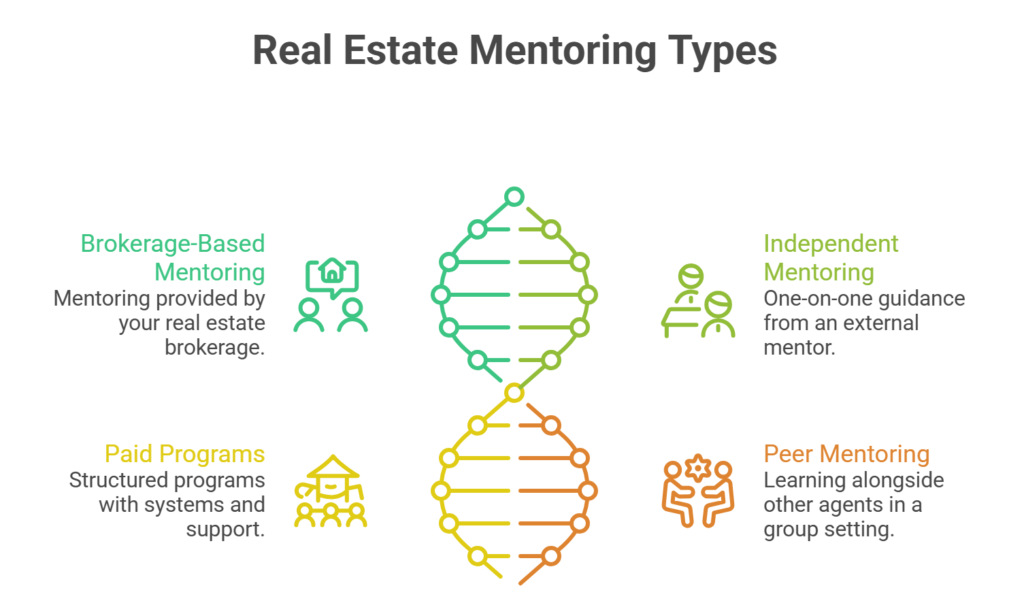
Real estate agent mentoring (brokerage-based)
This is the most common one.
You join a brokerage, and mentoring is built in. Someone shows you the ropes, helps with your first deals, and answers questions. Sounds good. And sometimes it is.
But here’s the catch: it’s usually tied to splits, team structure, or onboarding speed.
So the support can feel a bit rushed. Or generic.
It works if:
- You need basic guidance to get started.
- You’re okay learning fast and figuring things out as you go.
It falls short if you want deeper, ongoing input.
Independent real estate mentoring
This is outside your brokerage.
You connect with someone directly. Could be a top agent, an investor, someone you met through deals or networking.
This is where things usually get more real.
Advice is more honest. Less tied to company structure. More focused on how you want to build your real estate career.
But you have to find the right person yourself. No one’s assigning this to you.
Paid real estate mentoring programs
Now you’re paying for structure.
These programs can be 1:1 or group-based. They usually come with systems, calls, resources, and a clear path to follow.
Good ones bring consistency. You’re not waiting around for answers.
Bad ones? They feel like recycled content and surface-level advice.
So you have to vet them hard before jumping in.
Peer/group mentoring (masterminds)
This is more collaborative.
You’re learning with other agents at a similar stage. Sharing what’s working, what’s not, comparing notes.
It’s useful for perspective. You realize you’re not the only one figuring things out.
But don’t expect deep guidance here. No one’s really “leading” you.
Choosing based on your stage
This is the part that makes everything click.
- Just getting started? You need hands-on guidance. Someone who helps you not mess up your first deals.
- Closing a few deals, but inconsistent? You need structure and strategy. Not random advice.
- Switching niche or market? You need someone who’s already operating in that space.
Pick based on where you are right now. Not where you wish you were.
What to Look For in a Real Estate Mentor
Alright, so now you know your options.
The next question is simple: how do you know if someone’s actually a good fit?
Because experience alone doesn’t cut it. There are plenty of experienced agents who can’t explain what they’re doing.
Here’s what to pay attention to:
- Relevant and recent experience. They should be active in today’s market. Not just talking about deals from five years ago.
- Ability to explain decisions clearly. If they can’t break things down, you won’t learn much from them.
- Availability when it matters. Deals don’t wait. If they disappear when things get urgent, that’s a problem.
- Clear incentives and expectations. You should know what they expect from you and what you get in return. No confusion.
- Alignment with your goals and working style. If they build their business one way and you want something different, friction shows up fast.
Simple rule: If you leave conversations more confused than before, that’s not your mentor.

Where to Find a Real Estate Mentor
Now, where do you actually find a real estate mentor like that?
Because they’re not always sitting there waiting to be assigned to you. You have to look a bit. And more importantly, you have to filter.
Here’s where to start:
- Inside your brokerage. This is the easiest option. It’s right there when you join. Just don’t assume it’s the best one for you. Some brokerage mentors are great. Others are just filling a role. Pay attention to how they actually help you, not just their title.
- Through deals, networking, and referrals. This is where you’ll find some of the best mentors. You work a deal with someone sharp. You see how they think, how they move, how they negotiate. That’s a signal.
- Online (and how to filter noise). LinkedIn, YouTube, groups… there’s a lot out there. The problem is, visibility doesn’t equal experience. Look for people who break down real deals. If everything sounds polished and perfect, take a step back.
- When paid mentoring makes sense. If you can’t find the right person organically, paying can make sense. But only if there’s structure, access, and real involvement. Not just videos and templates.
Quick way to think about it: don’t chase titles or popularity. Pay attention to how people think and how they explain things.
That’s what you’re really buying into.
How to Choose a Mentor (Without Overthinking It)
At this point, you probably have a few options.
Now comes the part where most people get stuck. But you don’t need a perfect decision here; what you need is a solid one.
Here’s how to make it:
Questions that reveal fit fast
You don’t need a long interview. Just ask a few direct questions and listen carefully.
- How do you mentor?
- Who do you usually work with?
- What do you expect from me?
That’s it. You’re looking for clarity, not perfect answers.
If they’re vague, rushed, or can’t explain how they work, that’s your answer.
Test before committing
Don’t lock yourself in too fast. Have a few conversations. Bring real situations. See how they respond.
Do they actually help you think? Do you leave with more clarity? Or do they challenge you a bit?
You’ll feel it pretty quickly.
Red flags to watch for
Some things are easy to miss early on. Watch for these:
- They talk more about themselves than your situation.
- Advice feels generic or recycled.
- They push you toward their way of doing things without context.
- They’re hard to reach when you need input.
If you see two or three of these, don’t force it. There are better options out there.
Making the Relationship Work
Alright. You found a real estate mentor who feels like a good fit.
Now comes the part most people mess up.
This doesn’t work on autopilot. You don’t just “have a mentor” and magically improve. If you don’t use the relationship right, nothing changes.
Here’s how to make it count:
Set expectations early
Don’t leave this vague. How often are you talking? Are they reviewing deals or just giving general advice?
Get clear upfront. If not, you’ll be waiting for help… while they think everything’s fine.
Be proactive
Your mentor isn’t chasing you. If you disappear, the relationship just fades. That’s on you.
So, show up with something real:
- “I’m stuck on this client.”
- “This deal doesn’t make sense to me.”
The more specific you are, the better the guidance.
Apply what you learn
This is where most people drop off. They ask questions. Get solid input. Then… nothing.
No action or follow-up. That’s a waste.
Try what they tell you. See what happens. Come back with results. That’s how you improve fast.
Know when to move on
Not every mentor is long-term. You might outgrow them. Your goals might shift. The dynamic might just stop working.
It happens. If you’re not getting value anymore, don’t force it. Find someone who fits your next stage.

Choosing the Right Real Estate Mentor Comes Down to Fit
Here’s the deal. The right real estate mentor isn’t the most visible one. Not the one with the biggest numbers either.
It’s the one that fits how you think and how you want to build your real estate career.
So keep it simple: Talk to people, ask direct questions, pay attention to how they think. And test the fit before you commit.
At Estate Skyline, we help real estate businesses and agents figure the mentoring part out. If you’re serious about doing this right, it’s worth having that conversation.
FAQs
What does a real estate mentor do?
They help you think through real situations. Deals, clients, pricing, strategy… the stuff that actually matters day to day. You bring the situation, and they help you break it down so you can make a solid call.
How do I find a good real estate mentor?
Start close. Your brokerage, people you’ve done deals with, agents you trust. That’s usually where the best ones show up.
You can check LinkedIn too, just don’t get distracted by who’s the loudest. Pay attention to how people explain things. That tells you way more.
What qualities should I look for in a real estate mentor?
Look for someone active in the market right now. They should be able to explain their thinking clearly, so you understand why something works. And they need to be available when it matters, especially when you’re in the middle of a deal.
If you’ve got those three, you’re in a solid spot.
Is it worth it to hire a real estate mentor?
It can be. But only if you’re getting real access and real input.
If it’s just videos, templates, or generic advice, skip it. You’re better off building a relationship with someone who’s actually in the trenches.


- TL;DR
- What Is a Real Estate Mentor
- What a Real Estate Mentor Really Brings to the Table
- The Part Most People Miss: A Mentor’s Approach
- Types of Real Estate Mentoring (And Which One Fits You)
- What to Look For in a Real Estate Mentor
- Where to Find a Real Estate Mentor
- How to Choose a Mentor (Without Overthinking It)
- Making the Relationship Work
- Choosing the Right Real Estate Mentor Comes Down to Fit
- FAQs