Key Real Estate Agent Skill Requirements You Need to Win Clients in 2026

You got your license as a real estate agent. Nice.
Now what?
Because this is the part where things usually get quiet. No steady leads or real traction. Just a lot of waiting and trying to figure out what’s missing.
If you look closely, the real estate agent skill requirements that matter aren’t the ones you studied for the exam. They show up when you’re talking to a client, pricing a home, or trying to keep a deal from falling apart.
In the next sections, we’ll break down the skills that separate a struggling agent from one who consistently gets deals done.
Let’s get into it, shall we?
TL;DR
If you want the short version, here it is:
- Your license gets you in, but skills get you paid.
- Communication and trust decide who wins the client.
- Negotiation impacts both your client’s outcome and your commission.
- Market knowledge builds credibility fast.
- Follow-up and sales skills turn conversations into closings.
- Tech is no longer optional – agents using AI and CRM tools move faster.
- Referrals come from relationships, not just transactions.
- Top agents focus on positioning, marketing, and client experience.
Miss a few of these, and you’ll feel it right away in your pipeline.
What Real Estate Agent Skill Requirements Really Imply
Most people hear “skill requirements” and think about licenses, exams, and maybe a few legal basics.
That’s not what this is about.
What matters shows up when you’re sitting across from a client, or even just texting them back. The tone, the clarity, how confident you sound when things get tense. That’s what people react to.
And here’s the part that catches most new agents off guard: nobody walks you through this once you’re in. You’re expected to figure it out while the market keeps moving.
So before you spend time chasing more certifications, it’s worth getting clear on what these requirements look like:
Skill requirements vs licensing requirements
Getting licensed is structured. Skills? Not even close.
You follow a process to become a real estate agent. Courses, exams, approvals. Every broker expects that from day one.
After that, it’s a different game.
Nobody sits you down and shows you how to handle a nervous buyer, or how to push back in a negotiation without losing the deal.
That’s why two agents in the same brokerage can have completely different results. It usually comes down to how they communicate, how they position themselves, and how they manage each opportunity.
Why most new agents struggle (and what they lack)
You see this pattern all the time.
A new agent comes in motivated, ready to work, posting online, talking to people. But nothing really converts.
It’s frustrating because it feels like you’re doing everything you’re supposed to do.
What’s missing is usually pretty consistent:
- Weak communication that doesn’t build trust.
- No clear follow-up system.
- Hesitation when handling objections.
- Lack of confidence in negotiations.
That mix slows everything down.
How expectations change by market and niche
Not every real estate agent plays the same game.
- If you’re working with first-time buyers, you’ll spend more time explaining, guiding, and reassuring.
- If you’re dealing with investors, the conversation shifts fast. Numbers, returns, and deal structure. Less emotion, more logic.
- And if you step into higher-end markets, presentation and positioning start to matter a lot more. People expect a different level of professionalism.
So yes, the core skills stay the same.
But how you use them changes depending on who you’re working with and the kind of deals you’re trying to close.
The Non-Negotiable Skills Every Real Estate Agent Needs
There are a handful of skills that show up in every single deal:
- Communication that builds trust fast. If your message is slow or confusing, clients feel it immediately. They want clarity and quick answers. When you keep things simple and stay responsive, people relax.
- Negotiation that protects your client. Every deal gets uncomfortable at some point. Price, conditions, timelines… This is where a lot of agents hesitate. Strong ones don’t. They stay calm, know when to press, and don’t let small issues break the deal.
- Market knowledge that makes you credible. Clients are paying attention, even if they don’t say it. The way you talk about pricing or trends tells them if you know your stuff. Speak clearly and back it up, and they start trusting your direction.
- Sales skills that turn leads into closings. Getting attention is not the hard part anymore. Turning that into a deal is where things get real. Knowing how to move a conversation forward, handle hesitation, and stay consistent with follow-up changes everything.
- Organization and time control. Things pile up fast. Different clients, different deadlines, calls, paperwork. It can get messy quickly. Without structure, deals slip. When you stay organized, everything feels smoother.
The Hard Skills That Keep Deals Moving
Now let’s talk about execution.
Deals fall apart because something slipped. A missed deadline, a weak listing, or poor follow-up.
This is where hard skills come in. The practical side of the job that keeps everything from falling apart mid-process.
Contracts and transaction basics
This part is non-negotiable. You need to understand what you’re putting in front of your client.
Contracts, disclosures, timelines, conditions. Every piece matters. Miss something here, and it’s not a small mistake. It can delay the deal or kill it completely.
Clients expect you to guide them through this without confusion. That means knowing what matters, what can wait, and where risks usually show up.
Listing and marketing execution
Getting a listing feels like progress. But if no one sees it, nothing happens.
Most agents already know this. Around 90% of agents with websites use them to showcase listings, as REsimpli reports. That tells you how central online visibility has become.
Still, just being online isn’t enough. Presentation makes the difference. Photos, angles, descriptions, and how the property is positioned.
And the bar keeps rising. Drone photography and video are already used by 52% of agents, per the National Association of Realtors (NAR). Buyers expect more than basic photos now.
Agents who invest in better presentation stand out quickly. The rest blend in.
Tech stack you can’t ignore
At this point, working without tech just slows you down.
CRMs, MLS platforms, automation tools. These are part of the day-to-day now.
Even the basics tell the story. eSignature is used by 79% of REALTORS®, and social media by 75%., as reported by the NAR.
Then there’s AI. Some agents are already using it daily. The NAR also noted that around 20% use AI tools every day, 22% weekly, and another 27% a few times a month. They use it to write listings, respond faster, and keep follow-up consistent.
You don’t need every tool out there.
But ignoring this completely? That puts you behind fast.
The Soft Skills That Actually Close Deals
Hard skills keep things moving. Soft skills decide if the deal even happens.
Here are the most important ones:
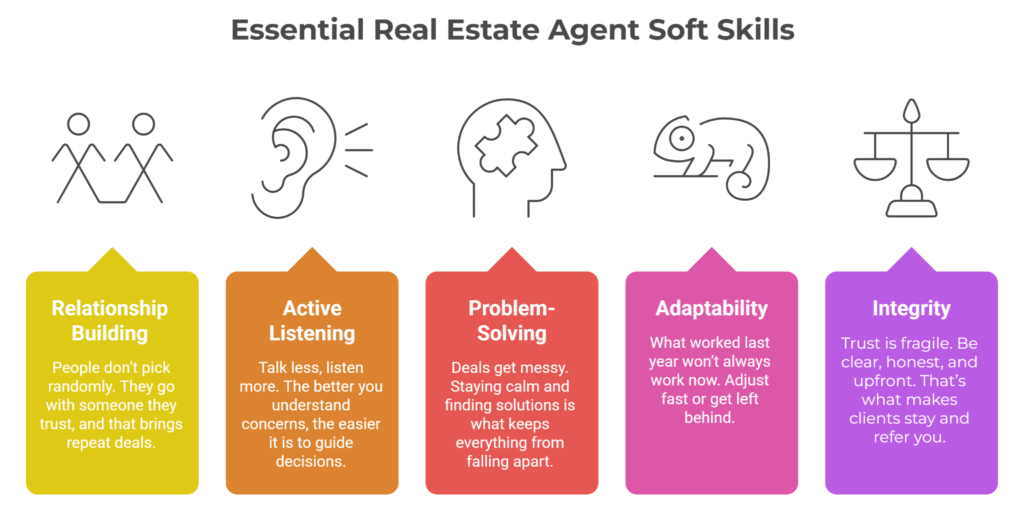
Relationship building that drives referrals
Around 42% of sellers find their agent through a referral from someone they trust. That alone should tell you where the real game is.
People don’t randomly pick agents. They go with someone recommended, or someone who feels reliable from the start.
And once you win that trust, it sticks. Per REsimpli, nearly 81% of sellers contact only one agent, and 75% say they’d work with that same agent again.
So this isn’t just about closing one deal. The point is building relationships that keep bringing business back.
That happens through consistent communication, honesty, and just being easy to work with.
Active listening and client psychology
Most agents talk too much. They explain, pitch, try to sound knowledgeable… and miss what the client is really saying.
Good agents listen first. They pick up on concerns, hesitation, and priorities. Not just what’s said, but how it’s said.
That changes the whole conversation. You stop pushing, start guiding, and clients feel that difference right away.
Problem-solving under pressure
Something will go wrong. Every time.
Financing issues, inspection surprises, and last-minute changes. It’s part of the job.
This is where clients really judge you. Do you panic? Do you pass the stress back to them? Or do you step in and figure it out?
Strong agents stay calm and look for solutions. They keep the deal moving instead of letting small issues turn into big problems.
That’s the kind of experience clients remember.
Adaptability in changing markets
Markets shift, sometimes fast. Interest rates change, inventory moves, buyer behavior flips.
Agents who rely on one way of doing things struggle when that happens.
The ones who adapt keep moving. They adjust pricing strategies, change how they generate leads, and shift their messaging.
That flexibility keeps their pipeline alive, even when the market gets unpredictable.
Integrity and transparency clients can trust
This one matters more than people like to admit; there’s already skepticism around the industry.
In fact, a report in Australia found that 27% of people experienced dishonest or unreliable tactics in real estate. That kind of perception doesn’t stay local. It affects how clients approach every agent.
So when you’re clear, honest, and upfront, it stands out immediately.
Clients notice when you explain things without hiding details, and when you give real advice instead of just trying to close. That’s what builds long-term trust.
The Skills That Separate Top Real Estate Agents From Average Ones
At a certain point, everyone has the basics. They can handle contracts, list a property, and talk to clients.
But results still vary a lot. Some agents stay stuck doing occasional deals. Others build a steady pipeline and grow year after year.
The difference shows up in a few key areas:
Personal brand and niche positioning
Trying to work with everyone usually leads to blending in. Clients remember specialists, not generalists.
Top agents get clear on who they want to work with. First-time buyers, investors, luxury properties, and specific neighborhoods. Something that gives them direction.
That clarity makes your message stronger and your outreach more effective. It also helps build a recognizable presence in your market.
Digital marketing that brings inbound leads
Outbound effort only gets you so far. Calling, messaging, networking. It works, but it takes constant energy.
Inbound changes the dynamic. According to REsimpli, around 52% of real estate agents already use social media for lead generation. That means half the market is actively trying to attract clients instead of chasing them.
The agents who do this well stay visible, share useful content, and build trust before the first conversation even happens.
So when a lead reaches out, the relationship is already warmer.
Data-driven decision-making
Top agents rely on data to guide pricing, timing, and strategy.
They look at comps, track market trends, and adjust based on what’s happening now, not what worked months ago.
This shows up in conversations with clients, too. When you back your recommendations with data, it builds confidence fast.
Client experience that creates repeat business
Closing the deal is not the finish line. The experience you create during the process decides if that client comes back or sends you referrals.
Top agents stay consistent from start to finish. They communicate clearly, stay organized, and make the process feel smooth. Nothing feels rushed or confusing.
That’s what turns one deal into multiple opportunities down the line.
Skill Requirements by Career Stage
Not every agent needs the same focus all the time. Here’s how to think about it depending on where you are:
New agents: Focus on survival skills
At the beginning, nothing matters more than getting into conversations. You need to get comfortable talking to people, following up without disappearing, and guiding basic buying or selling situations.
It might feel repetitive, but this is where your foundation gets built.
Growing agents: focus on efficiency and conversion
Once deals start happening, things get messy. You’re juggling leads, clients, and timelines. Some deals move forward, others stall.
This is where you clean things up. Better follow-up, better conversations, better negotiation. Small improvements here start showing up directly in your closings.
Top agents: focus on scale and leverage
At this stage, doing everything yourself starts working against you. The focus shifts to building something bigger. Delegating tasks, building a team, and strengthening your brand.
You’re no longer just working deals. Now, you are building a system that keeps bringing opportunities in.
How to Build These Skills Faster
Most agents try to figure this out alone. They watch a few videos, read some advice, test things randomly… and progress feels slow.
There’s a faster way to approach it if you’re more intentional:
- Mentorship and brokerage support. The right environment changes everything. Being around experienced real estate mentors gives you real context. You see how deals are handled, how conversations are managed, and what works in your market.
- Real practice over theory. You don’t get better by consuming more content. You get better by doing. Talking to clients, handling objections, and following up. Every real interaction sharpens your skills faster than any course.
- Courses, certifications, and coaching. Some training helps, especially when it focuses on specific skills like communication or negotiation. The difference comes from applying it immediately. If it stays as a theory, it won’t move anything.
- Feedback loops and performance tracking. If you don’t look back at what’s happening, you’re just guessing. Pay attention to where conversations drop, where deals stall, and where clients hesitate. That’s where your biggest improvements are.
Where Most Real Estate Agents Fall Short
Let’s call it like it is. A lot of agents stay busy… but not productive.
They’re posting, replying, and showing properties. But deals don’t move the way they should. And that’s frustrating, because it feels like you’re doing the work.
The problem usually comes from a few gaps that keep showing up.
- Weak follow-up systems. Most clients don’t decide right away. They need time, compare, and wait. If you don’t stay in touch, someone else steps in. The agent who follows up consistently is usually the one who gets the deal.
- No clear positioning or niche. Trying to help everyone sounds smart. In practice, it makes you blend in. When people don’t immediately get what you do or who you’re best for, they don’t remember you.
- Poor use of technology. Handling everything manually slows you down. Messages get missed, follow-ups slip, opportunities disappear. Meanwhile, other agents are using CRMs and automation to stay on top of everything without burning out.
- Inconsistent client experience. Some clients get great communication. Others get delays and confusion. That inconsistency kills trust. And without trust, there are no referrals.
Fix these, and things start feeling different fast.
The Right Skills Can Help You Grow as a Real Estate Agent

Here’s the truth most people realize a bit late: your license doesn’t build your business. Your skills do.
But you don’t need to master everything at once. Start with the skills that show up every day. How you communicate, follow up, and handle pressure when a deal gets tight.
That’s where your income really comes from.
And if you’re trying to grow faster or stop figuring everything out alone, having the right support makes a difference. At Estate Skyline, we work with real estate professionals and firms that want to level up how they hire, operate, and grow.
If you’re serious about building something that lasts, this is the moment to step it up.
FAQs
What type of skills do I need to be a real estate agent?
More than you probably expect. Communication skills, market knowledge, and negotiation are what really make the difference when you’re dealing with real buying and selling situations. That’s what separates someone licensed from someone who actually closes.
What role does market knowledge play in a real estate agent’s skill set?
It’s what makes people take you seriously. When you understand pricing and trends, you sound clear and confident. When you don’t, clients feel it right away. And if that happens, building a strong client base gets a lot harder.
How do negotiation skills impact a real estate agent’s success?
This is where deals are won or lost. When things get tense, you either step up or fade out. Strong negotiation keeps you in control, protects your client, and positions you as someone who knows what they’re doing. That’s what makes you a real negotiator.
How can real estate agents improve their client relationship management skills?
Don’t overcomplicate it. Reply fast. Be clear. Stay present. Most agents drop the ball on consistency. If you don’t, you stand out. And when you handle things right, you’re showing a level of code of ethics people can trust without having to question it.


- TL;DR
- What Real Estate Agent Skill Requirements Really Imply
- The Non-Negotiable Skills Every Real Estate Agent Needs
- The Hard Skills That Keep Deals Moving
- The Soft Skills That Actually Close Deals
- The Skills That Separate Top Real Estate Agents From Average Ones
- Skill Requirements by Career Stage
- How to Build These Skills Faster
- Where Most Real Estate Agents Fall Short
- The Right Skills Can Help You Grow as a Real Estate Agent
- FAQs