The 7 Stages of Recruitment Processes Explained (Step by Step)

You’ve probably been through this.
You open a role, applications start coming in, interviews get scheduled… and then things slow down.
The right people drop off. Decisions take longer than they should. And the hire you finally make doesn’t fully click.
It’s frustrating, especially when you know the problem isn’t effort.
What’s really happening is this: your hiring process doesn’t have a clear structure behind it. Each step depends too much on timing, opinions, or whoever’s available. And that’s where things start to break.
Once that happens, it’s hard to move fast or hire well.
That’s why getting clear on the stages of recruitment makes such a difference. It gives you control over the process, not the other way around.
Let’s break down how it should work from start to finish.
TL;DR
If you just want the quick version, here it is:
- A clear recruitment process helps you hire faster and avoid costly mistakes.
- Most hiring issues come from unclear stages, not a lack of candidates.
- The average time to hire is 24–30 days, but poor structure can stretch it much longer.
- You’ll get volume (around 73 applicants per role), but only a few will actually fit.
- Each stage should have a clear goal, criteria, and owner.
- Speed matters, but consistency matters more.
- A structured process helps you spot better candidates and close them before they drop off.
How the recruitment process works from start to finish
Hiring isn’t just posting a job and running interviews. It’s a sequence. And when one step slows down, everything after it does too.
You can see it in the numbers. The average time to hire sits between 24 and 30 days. If you include sourcing, the full time-to-fill goes up to around 45 days.
At the same time, volume isn’t the issue. Per industry benchmarks, each role gets about 73 applicants. Out of those, only 3 get interviewed, and just 1 gets the offer.
So the real problem sits in the middle:
- Too many resumes, not enough clarity on how to filter them.
- Inconsistent screening.
- Interviews that take time but don’t add much.
- Slow decisions that cost you strong candidates.
That’s where most hiring processes break.
You can have the right tools, a solid recruiter, and good job boards. But if the process behind it isn’t clear, things get messy fast.
What works is simple: clear stages, clear criteria, and a clear next step at each point. That’s what keeps things moving and helps you make better calls without dragging the process out.
Meet the stages of the recruitment process
When your hiring process has clear stages, things move. Decisions get easier, and you stop second-guessing every step.
Here’s how the 7 stages of the recruitment process should look in practice:
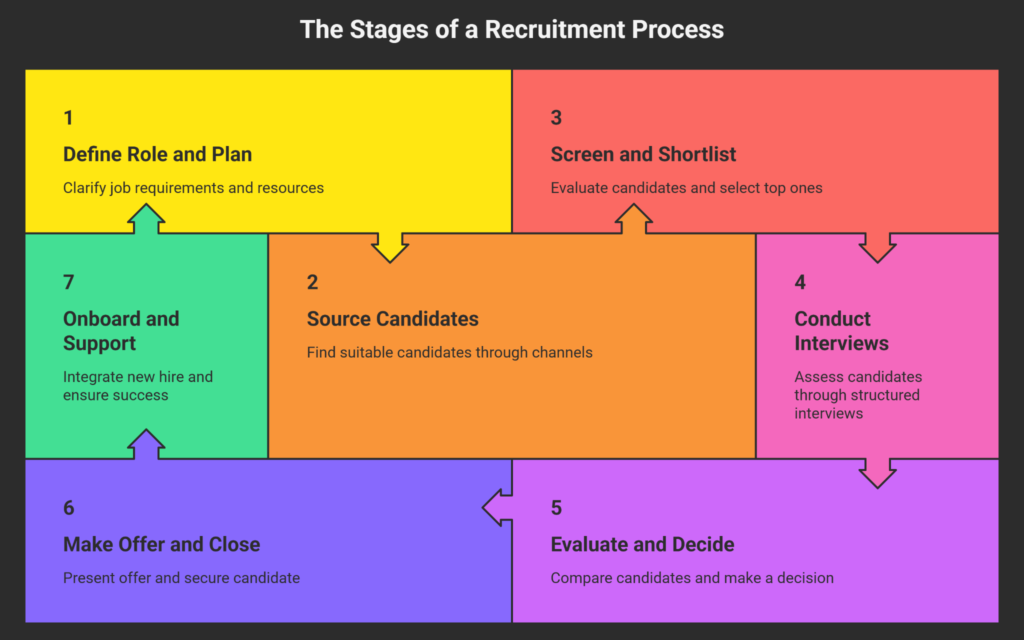
Stage 1: Define the role and hiring plan
Get this wrong, and everything else slows down.
Before opening the vacancy, be clear on what you need. Not in general terms. In real outcomes.
What should this person deliver in the first 3 to 6 months? That answer will guide everything that follows.
Then tighten your criteria:
- What’s non-negotiable?
- What can be learned on the job?
- What kind of background fits this role?
And don’t leave the basics for later:
- Budget and compensation range.
- Hiring timeline.
- Who’s responsible for each step?
Clarity here saves you hours later. Fewer irrelevant resumes, better interviews, faster decisions.
Stage 2: Source the right candidates
More candidates don’t mean better candidates. What you want is a pipeline you can actually work with.
Start with the right channels:
- Job boards for active candidates.
- LinkedIn for targeted outreach.
- Referrals from people you trust.
Then fix your job description. This is your first filter, not just a formality.
- Be clear about what the role does.
- Show what success looks like.
- Set expectations on experience and fit.
And don’t sit back waiting for applications.
Strong candidates are usually busy. They’re not refreshing job boards. You have to reach out and bring them in.
Stage 3: Screen and shortlist fast
This step moves faster than most people think.
Recruiters spend around 5–7 seconds on a resume before deciding if it moves forward. That’s all you get.
So if your criteria aren’t clear, screening turns into guessing.
Start simple. Know what you’re looking for before you open a single resume.
- Does the experience match the role?
- Are the key qualifications there?
- Is there anything that raises a red flag?
Then move quickly into short pre-screens. A 10–15 minute call is enough to confirm the basics and filter out weak fits early.
You’re not trying to “fully evaluate” candidates here. Just narrow things down.
Keep your shortlist tight. A few strong candidates beat a long list you can’t manage.
Key insight: Companies are getting 2.7x more applications than three years ago, but 88% admit they filter out qualified candidates by mistake. That’s what happens when screening isn’t structured.
Stage 4: Run a structured interview process
Interviews shouldn’t feel improvised. If every candidate gets a different set of questions or a different type of conversation, it’s hard to compare them later.
So, keep it consistent. Each interview should have a clear goal:
- One focused on skills.
- One on role fit.
- And one on team fit.
Ask the same core questions to every candidate. That gives you a baseline to compare.
Then use scorecards. After each interview, write down what you saw. Not just “good” or “not sure,” but specific strengths and concerns based on the role.
This keeps decisions grounded in evidence, not memory or gut feeling.
Stage 5: Evaluate and make the call

Now you’ve got your shortlist. This is where decisions either get clear… or messy.
If there’s no structure here, everything turns into opinions.
Pull feedback from everyone involved, but keep it focused. You’re not collecting random impressions. You’re comparing candidates against the same criteria:
- What did each candidate do well?
- Where are the gaps?
- How do they stack up against the role requirements?
Put it side by side. Same role, same expectations.
Disagreements will come up. That’s normal. What matters is how you handle them. Go back to evidence, not gut feeling.
And don’t rush just to close the role. A quick hire that doesn’t work out will cost you more time than taking a few extra days to get it right.
Stage 6: Make the offer and close the candidate
Getting to this point doesn’t mean you’re done.
Strong candidates are usually talking to more than one company. If your process slows down here, you lose them.
Keep it clear and direct.
- Build an offer that makes sense for the role and the market.
- Explain the full value, not just the salary.
- Be ready to answer questions and handle negotiations.
Speed matters here. Long gaps between decision and offer create doubt.
Also, don’t overcomplicate communication. Candidates want clarity. Where they stand, what the offer is, and what happens next.
A clean, fast close makes the difference between “we’ll think about it” and a signed offer.
Stage 7: Onboard and set them up to succeed
The hiring process doesn’t end when the offer is signed.
A lot of teams get this part wrong. They hire well, then drop the ball in the first few weeks.
If onboarding is unclear or rushed, even a strong hire can struggle.
Start before day one:
- Share what the first weeks will look like.
- Set clear expectations from the start.
- Make sure they know who to go to for what.
Then focus on early momentum:
- What should they achieve in the first 30, 60, 90 days?
- How will success be measured?
- How will you support them along the way?
Also, don’t leave integration to chance. Introduce them properly to the team and the way things work.
Good onboarding shortens ramp time and helps new hires settle in faster. That’s what turns a good hire into a strong one.
What makes a recruitment process run smoothly
Once all stages are in place, the difference comes down to how you run them day to day.
Some teams have the right structure but still struggle because execution isn’t consistent.
A smooth hiring process usually comes down to a few things:
- Clear ownership at every stage.
- Defined criteria before reviewing candidates.
- Fast timelines without rushing decisions.
- Consistent communication with candidates.
- Feedback loops to improve the process over time.
None of this is complicated. But skipping any of it slows you down and creates friction for both your team and your candidates.
When these pieces are in place, hiring feels more controlled.
Where recruitment processes usually break
Even with a solid structure, things can still go wrong.
And when they do, it usually comes down to the same patterns. Not enough clarity, too many steps, or slow execution.
You can see the impact on candidates. Around 42% drop out because scheduling takes too long, and 47% leave due to poor communication.
It adds up fast. Other reports note that 53% of candidates also say they’ve dealt with misleading hiring practices, and 34% feel ghosted after just one week.
That’s not a talent issue. In reality, it’s a process issue.
Here’s where things usually break:
- Misalignment in the role from the start.
- Too many interviews without adding real value.
- Weak or slow communication.
- Decisions based on gut feeling instead of structure.
- No real follow-through after the hire.
None of these looks serious on its own. But together, they slow everything down and push good candidates away.
How to adapt your recruitment process to your needs

Not every team hires the same way. And your process shouldn’t look exactly like someone else’s.
The structure stays the same. The way you run it changes depending on your situation.
Here’s how to adjust it without losing control:
Small teams vs larger organizations
Smaller teams need speed. Fewer people involved, fewer steps, faster decisions. Long interview chains don’t work here.
On the other hand, larger organizations need alignment. More stakeholders mean more coordination. Clear roles and structured feedback become critical to avoid delays.
High-volume hiring vs specialized roles
High-volume hiring is all about efficiency. You need quick screening, simple criteria, and a process that can handle a lot of candidates without slowing down.
Specialized roles are different. Fewer candidates, but higher stakes. You’ll spend more time sourcing and evaluating. The process needs to be tighter, not longer.
Remote hiring vs on-site roles
Remote roles open up your talent pool. But they also require clearer communication and stronger evaluation during the interview process. You don’t get in-person signals, so structure matters more.
Meanwhile, on-site roles are more straightforward. But they still need consistency. Just because candidates come into the office doesn’t mean the process should be loose.
Urgent hires vs long-term strategic roles
Urgent hires need speed. But speed without structure leads to bad hires. Keep the stages, just move faster through them.
Strategic roles need more depth. More alignment, careful evaluation, and clearer expectations from the start.
Different pace, same process.
Bottom line: A clear process makes hiring easier
When hiring feels slow, frustrating, or inconsistent, it’s rarely about the candidates. It’s the process behind it.
You can have good people applying. Even a solid recruiter. But if each stage isn’t clear, things slip.
On the flip side, when the process is tight, everything flows better.
You know what you’re looking for. You move faster. Conversations are more focused. And when the right candidate shows up, you don’t hesitate.
That’s the difference.
You don’t need to reinvent how hiring works. You just need a structure that holds up when things get busy.
If you’re hiring in real estate and want that kind of process in place, Estate Skyline helps you get there. You’ll get real support across the full hiring process.
That way, you can bring in the right people without dragging it out.
FAQs
What are the 7 stages of the recruitment process?
They’re the steps that take you from “we need to hire” to “this person is fully onboarded.” You define the role, bring in candidates, filter them, run interviews, make a decision, send the job offer, and get them started.
Looks simple in theory, but each step needs to be clear for it to work.
How does the recruitment process progress from start to finish?
It starts with clarity. What do you need and why? Then you bring potential candidates in, review them, talk to the best ones, and narrow it down. After that, you make the call, close the candidate, and get them up to speed.
When each step flows into the next, the whole process feels a lot lighter.
Why is it important to follow specific stages during recruitment?
Because without them, everything depends on timing and opinions. One candidate gets a great experience, another gets a rushed one. Decisions take longer because there’s nothing to compare against.
A clear selection process keeps things fair, faster, and way easier to manage.
What can go wrong at each stage of the recruitment process?
A lot, if you’re not careful. You might define the role too loosely and struggle to recruit the right people. Or bring in candidates, but filter them poorly. Interviews can turn into random conversations instead of a real evaluation.
Then decisions get delayed, offers take too long, and candidates walk away. And even after hiring, weak onboarding can throw everything off. In some cases, teams try to automate too much too early, which ends up hurting the experience.