Recruitment Consultants: Who They Are, and How to Become One

Recruitment is no longer just an HR function; now it has become a business growth driver.
In a market where qualified talent is hard to find and roles need to be filled yesterday, recruitment consultants are becoming the secret weapon for companies that want to scale without compromising on quality.
And we’re not just talking about a small change. The global recruitment market is on track to reach USD 968.33 billion by 2026 and skyrocket to USD 2.93 trillion by 2035. That’s the size of an entire industry built around helping businesses find the right people, faster.
So, if you’re rethinking your career in human resources or coming from a sales background, this guide is for you. Here, you’ll learn what recruitment consultants actually do, what it takes to become one, and why this career keeps growing.
Plus, if you’re in real estate? We’ll show you exactly how specialized recruiters give firms an edge.
Let’s begin, shall we?
TL;DR
Short on time? Here’s a quick recap:
- Recruitment consultants help companies fill roles faster with better-fit talent.
- 72% of employers say it’s tough to find qualified candidates.
- 80% of companies outsource at least one HR function, and recruitment is #1.
- Consultants handle everything from sourcing to hiring and post-placement support.
- They work via agencies or as independents, both with high earning potential.
- Real estate firms rely on them for sales roles where speed and volume matter.
- Active candidates are just 25% of the market; consultants access the other 75%.
- You don’t need a specific degree. Sales, HR, and ops backgrounds are common.
- Income includes base + commission. Top performers can hit six figures.
- In real estate, consultants reduce hiring friction and help brokerages scale.
What Is a Recruitment Consultant?
A recruitment consultant helps businesses find and hire the right people faster, smarter, and with less risk.
That’s the short version. But the role goes far beyond just reviewing résumés.
Recruitment consultants act as strategic partners. They work closely with hiring managers to understand the type of candidate needed, craft the right approach to attract them, and guide both sides through the process until the hire is made.
Some specialize by industry. Meanwhile, others focus on job levels, from junior roles to C-suite executives.
So, why do companies rely on them? Because hiring is hard, especially now:
- 72% of employers globally say they struggle to find qualified talent.
- 80% of companies now outsource at least one major HR function. Recruitment is the most commonly handed-off task.
- Among small businesses, 37% outsource recruitment and HR to stay competitive against larger firms with full internal teams.
Hiring the wrong person delays results. And hiring too slowly means losing talent to the competition. That’s why recruitment consultants are critical partners in business growth.
Recruitment Consultant vs Recruiter vs Headhunter
These terms get tossed around like they mean the same thing, but they don’t:
- A recruitment consultant works closely with companies to manage the full hiring process, often across multiple roles or departments. They take a consultative approach, offering strategy and guidance.
- Meanwhile, a recruiter typically focuses on sourcing and screening candidates, either in-house or for an agency.
- Lastly, a headhunter is more specialized. They’re usually hired to fill high-level or hard-to-find roles and operate with a narrow, targeted approach.
The overlap exists, but the key difference is scope. Recruitment consultants stay involved from the moment a role is scoped to post-hire onboarding, especially in ongoing partnerships or high-volume hiring settings.
Agency-Based and Independent Recruitment Consultants
Some consultants work inside recruitment agencies. Others go solo.
Here’s what that looks like:
- Agency-based consultants work as part of a team, usually with access to shared candidate databases, marketing tools, and back-office support. They’re ideal for those starting or handling large-scale recruiting.
- Independent consultants run their own business. They build their own client base, control their pricing, and operate with more freedom. However, they also carry the full responsibility of managing clients, legal structure, and lead generation.
Both paths are viable. It depends on your risk tolerance, experience, and whether you prefer structure or flexibility.
What Does a Recruitment Consultant Do?
A good recruitment consultant doesn’t just “find people.” They guide the entire hiring journey, from understanding what the client really needs to sourcing, screening, negotiating, and onboarding.
Let’s break it down:
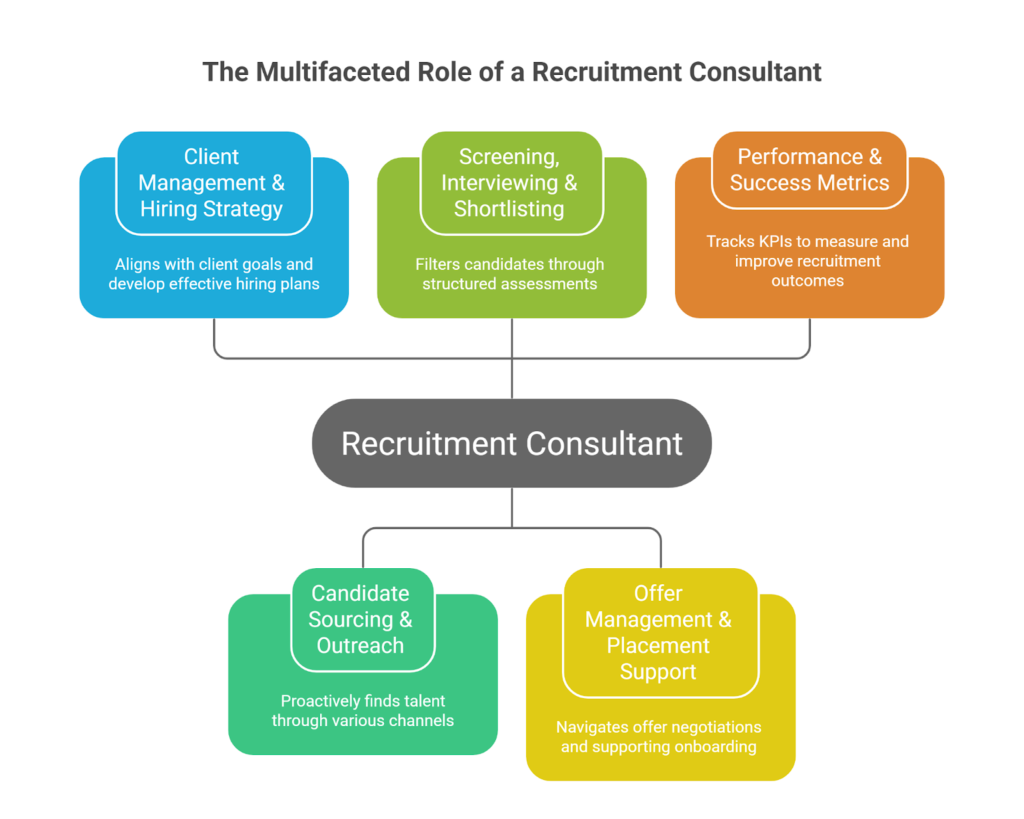
Client Management and Hiring Strategy
Before any sourcing happens, a good recruitment consultant starts with one thing: clarity. That means sitting down with the client and asking the right questions.
What’s the real reason they’re hiring? Is it team expansion, backfilling, launching a new vertical, or fixing a past hiring mistake? What soft skills matter in their culture? What red flags have they missed before?
Recruitment consultants use these insights to shape a hiring strategy that works. They typically:
- Clarify what success looks like in the role.
- Define must-have vs. nice-to-have skills.
- Align hiring strategy with business outcomes.
Key Insight: A bad hire can cost up to 30% of the employee’s first-year salary, according to the U.S. Department of Labor. And some estimates go even higher, from $240K to $850K per hire. That’s why getting aligned from the start is essential.
Candidate Sourcing and Talent Outreach
This is where most internal teams fall short, because sourcing takes time, tech, and focus.
Consultants don’t wait for applications to roll in. Instead, they create outreach strategies that match the market and the role. That means hunting down profiles, writing targeted messages, and keeping pipelines warm across multiple channels.
Some of the sourcing methods include:
- Internal databases
- LinkedIn and niche platforms
- Referral networks
- Direct outreach
- Passive candidate mapping
And here’s the kicker: Most hiring strategies focus on active candidates, who only represent 25% of the workforce.
That means 75% of potential hires are being missed, which includes professionals who aren’t job hunting but would move for the right opportunity. And recruitment consultants give companies access to that silent majority.
Screening, Interviewing, and Shortlisting
Once candidates are in the pipeline, the real filtering starts.
Consultants look for patterns. Career progression, gaps, transitions, value-adds. They know when a candidate is underselling themselves or hiding red flags in plain sight.
The interview process isn’t just a chat either. It’s structured to test fit, motivation, and potential. And it’s done fast, so clients aren’t stuck reviewing 30 CVs when 3 solid options will do.
Here’s what that process looks like:
- Reviewing résumés for alignment and potential.
- Conducting screening calls or video interviews.
- Running basic assessments if needed.
- Presenting only top-fit candidates to the client.
This makes it easier for hiring managers to focus on the final decision.
Offer Management and Placement Support
When you finally find the right candidate, the job is just entering the most delicate phase.
Offer negotiations can derail fast if there’s miscommunication, salary mismatches, or competing offers. Recruitment consultants act as a buffer to smooth the process, clarify expectations, and protect the deal.
Their role here includes:
- Facilitating feedback between both sides.
- Helping structure competitive offers.
- Managing counteroffers, delays, or candidate concerns.
- Supporting onboarding to reduce early churn.
A good consultant keeps momentum high until the candidate signs, and sticks around to make sure things don’t fall apart in week one.
Performance Metrics and Success Indicators
You can’t improve what you don’t measure. And in recruitment, metrics are about proving value.
Consultants track performance across every step of the funnel. It’s how they show clients what’s working, what’s lagging, and where strategy needs adjusting.
Common KPIs include:
- Time to fill
- Interview-to-hire ratio
- Candidate retention after placement
- Client satisfaction
Some also measure candidate experience scores, because a smooth process increases acceptance rates and protects your brand in the market.
Recruitment Consultants in Real Estate: How the Work (and the Stakes) Change
Most recruitment consultants work across industries. But when you step into real estate, the rules shift.
In real estate, you’ll be hiring producers. Agents, leasing managers, sales team leads. The kind of roles where performance hits revenue fast. And unlike other industries, real estate firms often face volume hiring, high turnover, and intense local competition.
By 2024, there were over 532,200 real estate brokers and agents in the U.S., according to the Bureau of Labor Statistics (BLS). And the market’s still growing, with 3% projected growth through 2034,
What’s more telling? Nearly 90% of agents got recruitment calls in 2025, up from 71% the year before.
That means brokerages are competing for talent. And that’s where specialized recruitment consultants enter the stage.
Why Real Estate Requires Specialized Recruitment Consultants?
Real estate hiring isn’t like filling a desk job. You need people who can sell, adapt, and operate with minimal hand-holding.
The compensation model (hello, commissions) already limits the candidate pool. Add in location-specific licensing, brand culture, and competitive markets, and you’ve got a hiring puzzle most general recruiters can’t solve.
So, specialized consultants understand:
- The difference between a solo closer and a team player.
- What traits predict success in commission-based roles.
- How brokerage structures impact recruiting needs.
- Why timing matters more than in other industries.
Instead of wasting time with resumes that “might work”, they send people who close deals.
Roles Commonly Filled by Real Estate Recruitment Consultants
A real estate consultant knows which roles are more important and how to fill them fast. Typical placements include:
- Real estate agents and brokers
- Sales managers and team leads
- Leasing agents and property managers
- Inside sales agents (ISAs)
- Regional directors or multi-office leadership
- Transaction coordinators and back-office support
These are roles that directly impact revenue, retention, and growth. Having a hiring partner who gets that makes all the difference.
How Real Estate Recruitment Consultants Add Value
So, what makes a real estate recruitment consultant different from a generalist?
Simple: they move faster, bring better candidates, and align every hire with the brokerage’s growth strategy.
They know how to build trust with candidates, even the passive ones already working for a competitor. And they understand what high-performing agents want in their next move.
The value comes down to:
- Faster time-to-fill and lower drop-off rates
- Access to pre-vetted, market-ready talent
- Strategic hiring that supports production goals
- Less time wasted by internal staff on low-fit candidates
In short, they help real estate firms grow without burning out their internal teams or stalling revenue targets.
Skills Required to Be a Successful Recruitment Consultant in Any Industry
To succeed as a recruitment consultant, you need to juggle strategy, sales, communication, and organization. All while keeping clients and candidates moving.
Here’s what top consultants have in common:
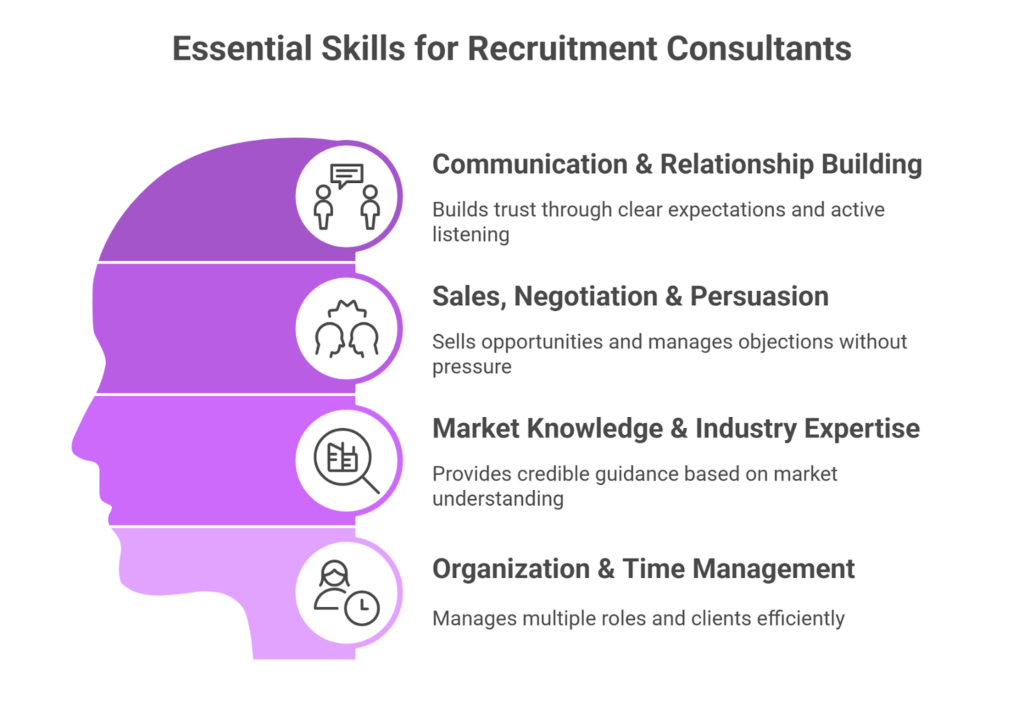
Communication and Relationship Building
Recruitment is built on trust. You’re guiding high-stakes decisions on both sides: career moves for candidates, hiring decisions for companies. That only works if people trust you.
That means:
- Listening more than talking during discovery calls.
- Communicating expectations clearly.
- Following up (and following through).
- Building long-term relationships, not one-off placements.
Sales, Negotiation, and Persuasion
Let’s call it what it is: recruitment is sales.
You’re selling the role to the candidate, and selling the candidate to the client. And sometimes, you’re negotiating salary, timelines, or expectations when both sides are hesitant.
Successful consultants:
- Frame opportunities with clarity and value
- Handle objections without pressure tactics
- Know when to push and when to pull back
- Keep momentum without sounding desperate
Market Knowledge and Industry Expertise
Generic pitch lines won’t get you far in this role. To gain trust and move quickly, you need to know the market you’re hiring in.
That includes:
- Salary ranges and commission norms
- Role expectations across different companies
- Market demand for specific skills or licenses
- The competitive landscape (especially in real estate)
Clients expect insight, and candidates expect context. Your market knowledge is what makes your recommendations credible.
Organization and Time Management
You might be managing five clients and 20 roles at once. That’s normal.
Without a clear process, things fall through the cracks; follow-ups get missed, great candidates lose interest, or interview loops stall.
That’s why top consultants:
- Use simple systems to track pipelines and tasks
- Set clear expectations with clients and candidates
- Prioritize roles that move quickly and deliver value
- Never leave anyone in the dark about what’s next
Speed without chaos is the goal. And that only happens with tight operations.
How to Become a Recruitment Consultant: A Clear Roadmap
You don’t need a fancy degree or 10 years in HR to break into recruitment. What you do need is a mix of business sense, people skills, and the ability to handle fast-moving conversations without losing the thread.
Let’s break down how to get started:
Educational Background and Career Paths
There’s no fixed academic path to becoming a recruitment consultant. But some backgrounds give you an edge, especially if you’re aiming to specialize in a niche like real estate or tech.
Helpful backgrounds include:
- Business, marketing, or communications degrees
- HR or psychology (for those coming from corporate)
- Sales or real estate certifications (if you’re industry-switching)
More important than the diploma is your ability to connect with people, think commercially, and move fast without dropping the ball.
Entry-Level Roles and First Steps
Most consultants start by learning the ropes inside an agency. Entry-level roles give you exposure to sourcing, screening, and managing hiring funnels before owning client relationships.
Common starting points include:
- Recruitment coordinator: Handles admin, interview scheduling, and ATS updates.
- Sourcing specialist: Builds top-of-funnel candidate pipelines.
- Junior recruitment consultant: Begins owning small client accounts or assisting senior consultants.
The key at this stage is learning how hiring decisions are made, so you can eventually guide them yourself.
Agency Experience vs In-House Training
You can break into recruitment in two main ways:
- Agency route: You’ll learn high-volume sourcing, fast turnaround, and client management. It’s competitive, but great for building speed and resilience.
- In-house (corporate) path: You’ll focus more on internal hiring processes, culture fit, and stakeholder alignment. It’s slower-paced but gives deeper exposure to internal HR.
If your long-term goal is to consult or go independent, agency experience usually sets you up better. You learn how to hunt, not just process.
Certifications, Training, and Continuous Learning
Recruitment isn’t a licensed profession, but that doesn’t mean training doesn’t help. So, you should consider:
- LinkedIn Recruiter Certification (for sourcing skills)
- AIRS Training or SHRM Talent Acquisition Courses
- Specialized real estate recruiting courses (if you’re focused on that niche)
That said, most of the real learning happens on the job: talking to candidates, managing expectations, and learning from the deals you win (and lose).
Building a Niche and Long-Term Career Growth
The best recruitment consultants don’t stay generalists forever. Once you’ve got your base skills, specialize.
Why? Because clients pay more for consultants who understand their industry inside out. And candidates trust you more when you speak their language.
Here’s how to grow long-term:
- Choose a niche: Real estate, tech, healthcare, finance, you name it.
- Learn the roles, the pain points, and the players.
- Build a reputation through consistency and delivery.
- Move up to senior roles, lead teams, or go solo as an independent consultant.
Recruitment is one of the few careers where income, freedom, and growth potential all scale fast if you know your value and own your space.
Career Outlook and Earning Potential for Recruitment Consultants

Let’s talk money. Because yes, recruitment can be rewarding, but only if you know how the game works.
The good news? You’re not stuck with a fixed salary. Most consultants earn a base plus commissions, and the ceiling is high if you perform well.
Salary Structures and Commission Models
Most recruitment consultants work under two compensation models:
- Base salary + commission: You get a stable income, with extra earnings based on placements. Commissions typically range from 10% to 30% of the candidate’s first-year salary.
- Commission-only (common in independent setups): You eat what you hunt, but the margins are bigger. A single hire can bring in $5K–$20K, depending on the role.
Key Insight: In real estate recruiting, where roles are volume-heavy and recurring, consultants often build long-term client retainers or get preferred vendor status.
Factors That Influence Income
Your earnings depend on a few key levers:
- Industry: Tech and finance tend to offer higher placement fees. Real estate offers scale and speed.
- Location: Consultants in major cities often close larger deals, but remote work is opening new markets.
- Experience: Senior consultants earn more through higher fees, repeat clients, and retained searches.
- Specialization: The deeper your niche, the more value you can command, and the less price-sensitive your clients are.
If you treat this as a business, not just a job, the financial upside is real.
Long-Term Career Opportunities
Recruitment isn’t a dead-end role. In fact, it’s one of the most flexible careers out there.
Here’s where it can take you:
- Senior consultant or team lead (within an agency or firm)
- Internal recruiter (for companies looking to scale)
- Recruitment manager or director
- Independent recruitment consultant (run your own show)
- RPO or talent advisor (consulting model for long-term hiring support)
Some even move into real estate business consulting or tech stack advisory, especially if they’ve built deep industry roots.
Bottom line? If you’re strategic, consistent, and client-focused, recruitment can grow with you.
Ready to Get Into Recruitment Consulting?
You’ve got the context, the numbers, and the reality check. Now it’s your turn.
As you could see, recruitment consulting is a career built on action, resilience, and real results. You’ll work fast, think sharp, and figure things out in real time. The learning curve? Steep. But the payoff (professionally and financially) is real if you commit.
And if real estate’s the niche you’re drawn to? Even better. It’s one of the fastest-paced, highest-impact fields for consultants who know how to deliver under pressure.
At Estate Skyline, we work with people who want in for real. If you’re aiming to grow in the recruitment world, especially in real estate, we’ll help you find your edge, sharpen it, and turn it into a career that goes the distance.
Think you’ve got what it takes? Let’s talk and build something solid.
FAQs
What is a recruitment consultant?
A recruitment consultant is the person companies call when they need to hire fast. They handle the full process: understanding the role, finding the right candidates, managing interviews, and closing the hire. It’s part matchmaker, part strategist, part operator.
What is the difference between a recruitment consultant and a recruiter?
Recruiters usually focus on sourcing. Consultants go deeper: they own the client relationship, help define hiring needs, and keep everything moving from start to finish.
Think of a recruiter as a part of the process, and a consultant as someone driving it.
How can a recruitment consultant help job seekers?
They know where the real opportunities are, and they’ll help you get in front of the right ones. A good consultant gives you honest feedback, preps you for interviews, and negotiates offers that make sense. You’re not just another résumé in the pile when they’re on your side.
What does a real estate recruitment consultant do?
They recruit agents, sales managers, leasing teams, and leadership roles for brokerages and property firms. But more importantly, they understand how the real estate game works (timing, licensing, commissions, turnover) and build teams that actually perform, not just fill seats.
What are the most important skills for a real estate recruitment consultant?
You need to have strong communication, persuasive sales instincts, a deep understanding of the local real estate market, and be able to manage time and priorities under pressure. Real estate consultants need to act fast, make sharp calls, and build trust on both sides of the hiring equation.


- TL;DR
- What Is a Recruitment Consultant?
- What Does a Recruitment Consultant Do?
- Recruitment Consultants in Real Estate: How the Work (and the Stakes) Change
- Skills Required to Be a Successful Recruitment Consultant in Any Industry
- How to Become a Recruitment Consultant: A Clear Roadmap
- Career Outlook and Earning Potential for Recruitment Consultants
- Ready to Get Into Recruitment Consulting?
- FAQs