Conversational AI in Real Estate: What’s its Business Impact?

Real estate moves fast. Buyers bounce if they don’t get answers within seconds. Leads vanish after 10 minutes.
And your team? They can’t be everywhere at once. That’s why more real estate firms are bringing in conversational AI as a real operational asset.
In fact, the real estate industry now leads all sectors in chatbot adoption, hitting 28%. That’s ahead of travel (16%) and even healthcare (10%), according to Thunderbit.
Why? Because this tech solves problems we all deal with: missed leads, slow response times, poor follow-up, and overloaded agents.
Next, we’ll break down how conversational AI works in real estate, where it’s giving results, and how to know if it makes sense for your business.
Let’s take a look, shall we?
TL;DR
If you have little time to read, here’s a quick recap:
- Real estate has the highest chatbot adoption rate of any industry.
- AI can reduce lead response time by up to 62% and increase conversions by 35%.
- 64% of real estate leads come from mobile; AI helps you catch them instantly.
- Speed matters: responding within 1 minute can boost conversions by 391%.
- Conversational AI is used for lead capture, appointment booking, tenant support, and more.
- It works 24/7, handles routine inquiries, and frees up agents to focus on qualified leads.
- Real estate recruiters are also using AI for screening and scheduling.
- But it’s not perfect; AI still struggles with emotional nuance and complex negotiations.
- This AI is best used as support, not as a replacement. Adoption should match your lead volume and team readiness.
Conversational AI in Real Estate: A Practical Overview
Let’s clear one thing up from the start: conversational AI isn’t just about putting a chatbot on your website.
It includes AI-powered tools that can understand natural language, respond like a human, and automate routine conversations, through chat or voice.
And in real estate, that covers a lot of ground: lead intake, showing requests, property inquiries, tenant FAQs, and even recruitment outreach.
There are two major types you’ll come across:
- Rule-based bots: These follow a decision tree. They’re fast but rigid. Great for FAQs or yes/no scenarios.
- Conversational AI systems: These use natural language processing (NLP) to understand intent and context. They can clarify questions, personalize responses, and handle more complex interactions across SMS, live chat, or even voice calls.
And clients are on board: 62% of consumers prefer chatting with a bot over waiting for a human agent. They want fast, clear answers without sitting on hold.
Here’s where it gets real. Today’s AI agents can handle up to 80% of routine customer inquiries without any human input, as reported by Thunderbit.
That means your team only steps in when it really matters: saving time and reducing dropped leads.
How Conversational AI Is Used in Real Estate Today
You don’t need a crystal ball to see where real estate is heading. The firms closing more deals are the ones answering faster, qualifying leads instantly, and following up without delays.
This is how conversational AI plays a key role in making that happen:
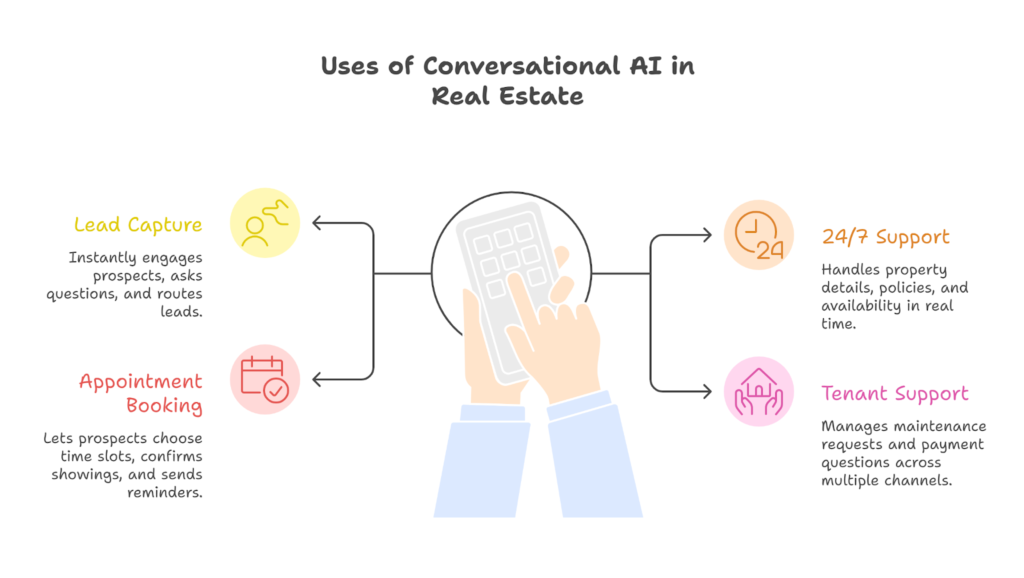
Lead Capture and Qualification
This is where AI delivers immediate value.
Instead of waiting for someone to fill out a form or hoping an agent is free, conversational AI engages leads the second they land on your site. It asks the right questions, segments them, and prioritizes follow-up based on real-time answers.
Here’s why it works:
- 35% increase in lead conversion when AI is used for initial engagement, according to Real Estate 7.
- Per the same source, 64% of real estate leads come from mobile, but 53% of users will leave a site if it takes longer than 3 seconds to load or respond.
- Responding within 1 minute boosts conversions by up to 391%.
- Waiting 10+ minutes cuts your chances of reaching that lead by up to 80%.
With conversational AI, you’re qualifying in real time and sending your best leads straight to your team while they’re still hot.
Property Inquiries and Listing Support
AI handles the repetitive stuff so your team doesn’t have to.
From property details and square footage to rental policies and showing availability, conversational AI can field common listing questions immediately. It pulls data directly from your system, so the info stays accurate and consistent.
That means prospects get what they need fast. That way, your agents can focus on high-priority conversations, not answering the same questions 20 times a day.
Appointment Scheduling and Follow-Ups
Trying to lock in a showing by email or phone is a time sink. With AI, that friction disappears.
These tools can offer available time slots, confirm appointments, send reminders, and even follow up after viewings. No back-and-forth or dropped messages.
It keeps your calendar full and your prospects moving forward without delays.
Client Support and Tenant Communication
Conversational AI also helps with everything after the sale or lease.
Need to submit a maintenance request? Ask about parking? Update contact info? AI can manage those routine support touchpoints via chat, SMS, or email, depending on where your tenants prefer to communicate.
For property managers, that means fewer phone calls and faster resolution times. And for tenants, it’s a better, smoother experience that doesn’t rely on business hours.
What are the Benefits of Conversational AI in Real Estate?
In this field, artificial intelligence is a tactical advantage. When used right, it brings speed, consistency, and clarity to operations that typically drain your team’s time and energy.
Here’s what real estate businesses are seeing on the ground:
Faster Response Times
In real estate, minutes matter. And when buyers or renters reach out, they don’t want to wait.
Here’s the kicker: Conversational AI shortens response times by up to 62%. That helps you meet rising expectations, because 82% of buyers now expect a reply in under 10 minutes, according to Real Estate 7.
The faster you respond, the more likely you are to win the deal. And AI helps you stay fast without burning out your team.
Lead Conversion at Scale
Real estate firms dealing with dozens of inquiries a day can’t afford bottlenecks.
Conversational AI scales your intake without overwhelming your agents. It qualifies leads automatically, shares relevant info, and only sends the serious ones to your team.
That consistency improves both volume and close rate, without adding headcount.
Better Client Experience
People don’t want to feel ignored or pushed. They want clarity, speed, and options.
AI assistants respond immediately, no matter the time or channel. That always-on availability builds trust early and keeps conversations flowing. And for common questions, the tone stays professional every time.
Operational Efficiency for Real Estate Teams
Your agents aren’t hired to chase paperwork or answer repetitive questions.
With AI handling scheduling, inquiries, and reminders, your team spends more time doing what they do best: closing deals and supporting serious buyers.
Can Conversational AI Help With Real Estate Recruitment Needs?
Short answer: yes. But only if you use it where it makes sense.
Recruiting in real estate is time-consuming. You’re processing role descriptions, candidate screening, interview coordination, and follow-ups… all while trying to keep deals moving. That’s exactly where conversational AI can take some weight off.
Here’s how smart firms are already putting it to work:
- Candidate pre-screening: AI can ask the right knock-out questions upfront: work eligibility, license status, language skills, and more. No need to manually chase down basic info.
- Role-related Q&A: Got 20 applicants all asking if the position is remote or what the commission split is? AI handles it in real time without flooding your inbox.
- Interview scheduling: The back-and-forth of setting up interviews is a black hole. AI can offer time slots, confirm bookings, and send reminders so no one drops off.
- Post-application follow-up: Ghosting works both ways. AI keeps candidates warm with updates, next steps, and simple check-ins.
What AI doesn’t do (and shouldn’t) is make the final call. Real estate hires still hinge on soft skills, cultural fit, and gut feel.
That’s where your recruiter or internal team steps in. But AI clears the noise, so they’re only spending time on the right people.
If you’re hiring for multiple roles, across markets, or supporting a growing team, this tech gives your process more structure. And it frees up hours every week.
Pro Tip: Want to see the bigger picture? Then, check our full breakdown of AI recruiting tools in real estate.
Limitations and Risks of Conversational AI in Real Estate
Conversational AI isn’t a silver bullet. Used well, it can sharpen your operations. But if you use it blindly, it can underdeliver or even hurt your brand.
Let’s break down where things can go sideways:
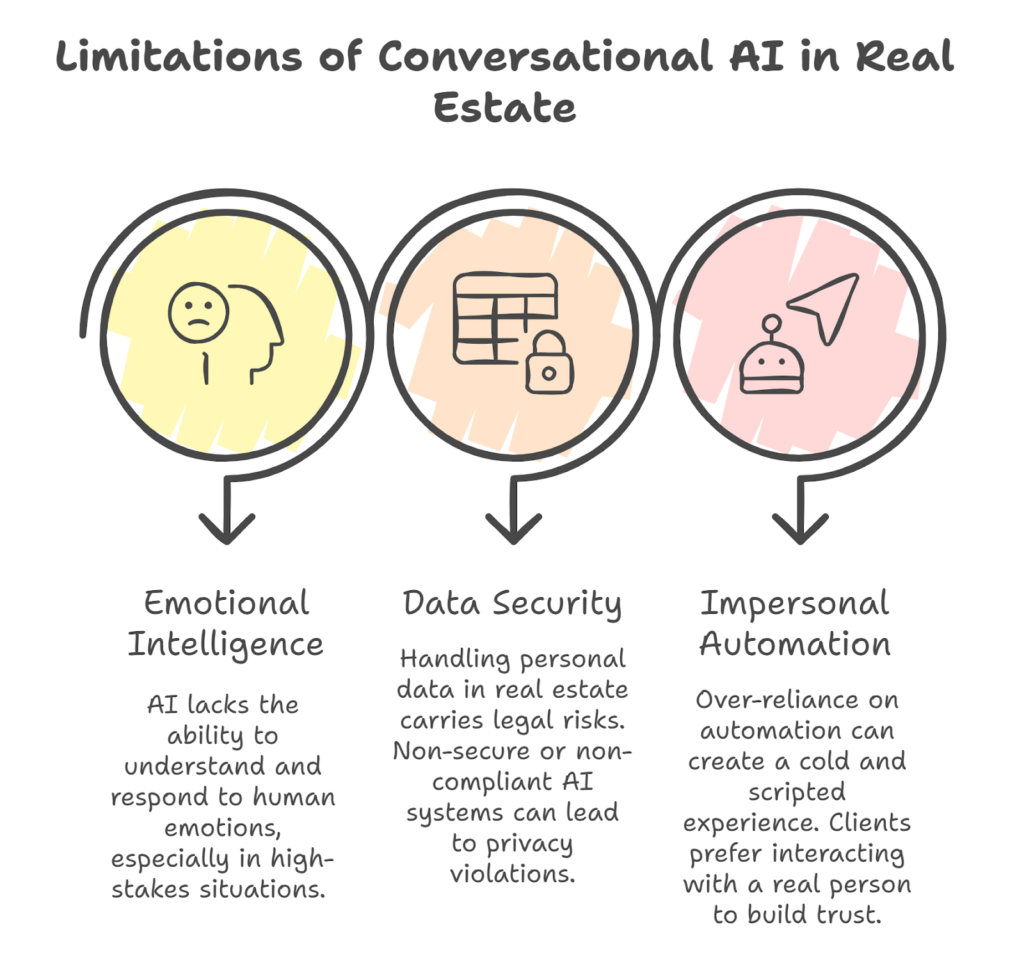
Limited Context in Complex or High-Stakes Situations
AI is fast, but it’s not intuitive.
If a buyer is emotionally attached to a home, or a tenant is angry about an unresolved issue, bots can miss the tone. They won’t pick up on hesitation, frustration, or subtle negotiation cues.
That’s why it’s risky to let AI handle sensitive tasks like price negotiations, legal disclosures, or anything involving client trust. Those moments still need a human touch.
Data Privacy and Compliance Considerations
Real estate deals involve sensitive data: IDs, financial info, lease terms, and more. If your AI tool stores or processes that data without proper safeguards, you’re opening the door to legal issues.
You’ll need to verify how data is collected, stored, and used. And if you’re working across borders, compliance gets trickier.
Bottom line here? Pick AI tools with airtight security and clear policies, and make sure your team knows the rules.
Over-Automation and Trust Concerns
There’s a fine line between helpful automation and robotic overkill.
If every interaction feels cold or scripted, clients notice. They start to wonder if there’s anyone real behind the brand. That erodes trust fast, especially in a relationship-based business like real estate.
And there’s more: even when firms adopt AI, they don’t always get the results they expect. A recent global survey by JLL found that while 88% of occupiers and investors are piloting AI, only 5% have hit all their goals. And nearly half are stuck hitting just two or three.
The tech works, but only if you deploy it with clear priorities and a strategy that supports your team (not replaces it).
How to Decide If Conversational AI Is Right for Your Real Estate Business
Let’s be honest: not every firm needs conversational AI right now. But if your operation is growing, your team is stretched thin, or leads are slipping through the cracks, it’s time to look closer.
Here’s how to figure out if this tech makes sense for your business today:
Lead Volume and Business Complexity
If you’re getting a handful of inquiries a week, you don’t need AI.
But if you’re managing dozens (or hundreds) of incoming messages across listings, rentals, client support, and recruitment, automation stops being optional.
The same goes for complexity. A firm handling multiple property types, markets, or client profiles has more moving parts. That’s where AI can help organize, qualify, and route the right info to the right place.
The more leads, listings, and internal processes you juggle, the more conversational AI can actually help.
Team Readiness and Process Maturity
Tech won’t fix a broken workflow.
Before you roll out AI, check: Do you have clear follow-up processes? Defined handoffs between AI and your team? Clean data? If not, start there.
Also, your team has to trust the system. If they’re constantly double-checking what the AI said or ignoring the leads it qualifies, you won’t get value from it.
Conversational AI as Support, Not Replacement
Here’s the mindset shift: AI is your digital assistant, not your new sales rep.
It helps your human team work faster, follow up better, and stay focused on deals that need their attention. The best real estate firms are using AI to support growth, without adding more chaos.
And the market shows it’s not just hype. JLL’s global survey also found that 92% of CRE occupiers are already piloting AI, testing an average of five use cases at once. Even more telling? 87% of investors increased their tech budgets because of AI.
The firms getting results aren’t automating everything. Instead, they are using AI to handle what’s repeatable, so their people can handle the important tasks.
Ready to Turn AI into a Real Estate Asset?
AI won’t magically fix slow follow-ups or messy handoffs. But used right, conversational AI becomes a real asset; something that actually pulls its weight.
Running a lean brokerage? Expanding across markets? Hiring while managing inbound leads? This tech helps you respond faster, stay organized, and keep your deals moving, without burning out your people.
And if you’re figuring out where to start or how to tie it all together, that’s where Estate Skylike enters the stage. We help real estate firms build systems that support real growth, from smarter hiring to better tech decisions.
Let’s talk, and turn your operation into something that runs sharper and smoother.
FAQs
What is conversational AI, and how is it used in real estate?
Conversational AI refers to tools (like chatbots or virtual assistants) that can hold real conversations via chat or voice. In real estate, it’s used to qualify leads, answer listing questions, schedule appointments, support tenants, and even help with recruiting. It runs 24/7, so you don’t lose leads just because your office is closed.
That kind of coverage is exactly why more teams are turning to conversational AI for real estate as part of their core setup.
Why is conversational AI becoming popular in the real estate industry?
Because clients want answers now, and real estate teams don’t always have someone available to respond. Using AI helps firms respond faster, stay consistent, and improve the overall customer experience at every stage, from first inquiry to post-sale support.
What are the main benefits of using conversational AI in real estate agencies?
It helps you stay responsive, qualify leads faster, and keep conversations flowing, even outside business hours.
For every busy real estate agent, that means fewer distractions and more time spent closing real opportunities. It also brings structure without adding extra headcount, which makes it a smart option for teams looking to scale with control.
Which real estate tasks should be automated with conversational AI first?
The best place to start is where volume is high and human input adds little value. That includes lead qualification, property inquiries, appointment booking, tenant requests, and interview scheduling.
These are repetitive tasks that don’t require personal judgment. Automating them frees up your team and gives you more room to grow without losing control of the process. That’s the foundation for long-term scalability.
How does conversational AI improve lead qualification and conversion in real estate?
It jumps in immediately, asks smart questions, and identifies who’s serious before your team even logs in. That way, your agents focus on real opportunities, not form submissions that go nowhere. And when you respond within a minute, your chances of closing go way up. That’s where AI makes a real impact.


- TL;DR
- Conversational AI in Real Estate: A Practical Overview
- How Conversational AI Is Used in Real Estate Today
- What are the Benefits of Conversational AI in Real Estate?
- Can Conversational AI Help With Real Estate Recruitment Needs?
- Limitations and Risks of Conversational AI in Real Estate
- How to Decide If Conversational AI Is Right for Your Real Estate Business
- Ready to Turn AI into a Real Estate Asset?
- FAQs