List of Fake Recruitment Agencies and Job Scams to Avoid in 2026

If you’re looking for a job right now, chances are you’ve already been contacted by a fake recruiter.
Maybe it came through email, text message, or on LinkedIn. The role looked real, the company name sounded legit. And for a moment, you considered it.
Well, that’s the market we’re in. Fake recruitment agencies have become very good at blending in. They copy real companies, steal recruiter identities, and post job listings that look no different from legitimate ones.
The data is loud. The FTC reported that losses from job scams jumped from $90 million in 2020 to over $501 million in 2024. And we’re still waiting for more recent numbers.
But this isn’t only a job seeker problem. Real recruitment agencies and employers are dealing with impersonation, damaged trust, and candidates who no longer know who’s safe to talk to.
That’s why we share here a recent list of fake recruitment agencies and the patterns behind them. We’ll also show you how to spot the red flags early and how to check if a recruitment agency is legitimate before you engage.
Read this once. It can save you a lot of time, money, and headaches later.
TL;DR
If you’re short on time, here are the main takeaways:
- Job scams cost victims over $500 million in 2024 alone, and the numbers have kept climbing since.
- Fake recruitment agencies are rising fast, and they look more legitimate than ever.
- Scammers target urgency: remote roles, fast hiring, and candidates under pressure.
- Any request for upfront payment, vague job details, or rushed decisions is a red flag.
- Most fake recruiters reach out via email, text, or LinkedIn.
- You can verify whether a recruitment agency is legit by checking registration, recruiter identity, and payment structure.
- Knowing what these scams look like upfront is the easiest way to avoid them.
List of Reported Fake Recruitment Agencies in 2026
There is no universal or official list of fake recruitment agencies. New names appear constantly, and scammers shut down and relaunch under different brands. There are also numerous Reddit discussions around that.
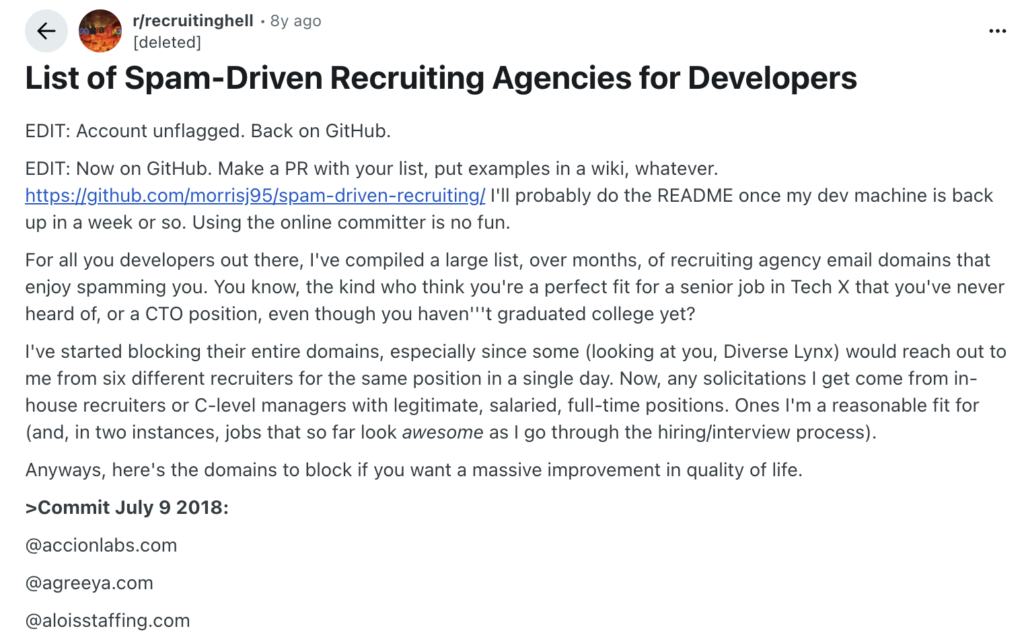
That said, the agencies below have been recently reported based on consistent scam indicators and public complaints:
- Pearl Talent. Scammers impersonate recruiters from a firm called Pearl Talent, often using the name “Katherine.” Outreach usually happens via SMS or WhatsApp and promises high-paying, low-effort remote work.
- Brooksource. This case involves scammers posing as Brooksource recruiters and contacting candidates by text. They promote remote work with high daily pay, vague duties, and push replies through SMS instead of a formal hiring process.
- Star Hill: This fake agency sends unsolicited messages claiming interest in the candidate’s résumé and directing them to follow up via email to secure an interview. The outreach lacks role details and relies on pushing the candidate to initiate contact.
- Talent Hunt HR: These “recruiters” request résumés in “ATS-friendly” format, then redirect the candidates to a specific website to reformat them. After resubmission, all communication stopped, which raises concerns about résumé-harvesting scams.
- Ark Solutions, Inc.
- Bluestone Staffing
- Enterprise Solution, Inc.
- Han Staffing
- KRG Tech
- Softpath
- US Tech Solutions, Inc.
- Vertigo Consulting
- Net 2 Source
- Ramy Info Tech
- B Computing
- Accion Labs
- Alois Staffing
- Panasia Group
- Tech Rakers
Besides them, these impostors talking on behalf of real companies had been reported in the BBB Scam Tracker by January 2026:
- Apetan Consulting (impersonators)
- Amazon (impersonators)
- Heidrick & Struggles (impersonators)
- Kelly Services (impersonators)
- Randstad (impersonators)
- Robert Half Recruitment (impersonators)
- VDart Consulting (impersonators)
- VXI Global Solutions (impersonators)
If a job offer or recruiter interaction matches the patterns behind these cases, that’s a sign to stop and verify before moving forward.
What Is a Recruitment Scam?
First off, a recruitment scam is exactly what it sounds like: someone pretending to offer a real job to take your money, steal your personal information, or both.
Fake recruitment agencies are one of the most common versions of this. These pose as staffing firms, headhunters, or talent consultants. Some invent companies from scratch. Others copy the name, branding, or recruiter profiles of real companies. In many cases, they do both.
The goal isn’t to help you land a job. Instead, they aim to get you to act before you slow down and verify anything. That usually happens in a few predictable ways:
- Asking for fees tied to background checks, visas, training, or onboarding.
- Collecting personal information under the excuse of “payroll setup.”
- Running fake interviews that feel real enough to lower your guard.
- Sending professional-looking job offers that don’t hold up once you look closely.
What makes this especially dangerous is how normal it all feels. The emails are polished, the job posting looks legitimate, and the recruiter sounds confident.
And because real recruitment agencies do exist and operate this way, many people don’t realize they’re dealing with a scam until money or personal data is already gone.
Why Recruitment Scams Are More Common Than Ever
This surge didn’t happen randomly. A few shifts made recruitment scams easier to run and harder to spot.
Here’s what’s driving it:
Remote hiring and global talent markets
Remote work opened doors for legitimate hiring, but also for scammers.
Today, a recruiter doesn’t need to be in your city, your country, or even your time zone. That makes fake agencies harder to verify and easier to excuse when things feel slightly off.
Different accents, delayed replies, “international hiring partners.” All of that sounds normal now.
Authorities are seeing the impact globally. In Australia alone, the Job Scam Fusion Cell referred 1,850 scam websites and ads for removal in just six months.
Meta removed around 29,000 scam-related accounts from Australian Facebook groups during that same period.
So yes, this is organized, and it’s going cross-border.
High competition and candidate urgency
Scammers thrive on pressure, and the job market gives them plenty of it.
When candidates are applying to dozens of roles, waiting weeks for replies, and worried about income gaps, urgency kicks in. A fast response feels like relief, and a quick job offer feels like luck.
That’s where fake recruiters act. They promise speed, skip steps, and tell you they’re moving fast “because the client needs to hire immediately.”
Once urgency is in play, verification usually drops.
Easy access to stolen corporate identities
Scammers no longer need to invent credibility. They steal it; real recruiter names, company logos, employee LinkedIn profiles… All copied and reused.
Some fake agencies run entire operations using identities scraped from legitimate firms, which makes them nearly indistinguishable at first glance.
This is one reason job scams have jumped in recent years. It’s also why text-based job scams grew from fewer than 5,000 reports in 2020 to more than 20,000 in 2024, with losses climbing from $2 million to $61.2 million.
Low barriers to creating professional-looking brands
A clean website used to mean something. It doesn’t anymore.
Scammers can launch a polished recruitment site in a day. Stock photos, fake testimonials, generic service pages, and even fake client logos.
None of it is hard to build, and most people don’t check beyond the surface.
Key Insight: McAfee reported that job-related scams increased by over 1,000% between May and July of 2025 alone. That spike lines up perfectly with how easy it’s become to look legitimate online without being legitimate.
How Do You Spot a Fake Recruitment Agency?
Most people fall for fake recruitment because the scams look normal. In fact, a 2025 survey by Password Manager found that 60% of U.S. job seekers encountered at least one fake job post or recruiter during their search.
That tells you something important: spotting a fake recruitment agency is about knowing what to check.
Let’s break it down:
Common types of fake recruitment agencies
Fake agencies usually follow a few repeatable models. Once you know them, they’re easier to recognize:
- Ghost agencies: These look like real recruitment firms at first glance. They have polished websites, but no legal registration, physical address, or real team. Conversations quickly shift toward visa, accreditation, or onboarding fees.
- Shadow agencies: These rely on confusion. The scammer uses a company name that’s almost identical to a legitimate agency. One letter off or a word missing. For example, “Radstad” instead of Randstad. It’s easy to miss unless you check carefully.
- Imposter agencies: This is the most aggressive version. Scammers pose as well-known companies and communicate through unofficial channels like Gmail, WhatsApp, or Telegram. The brand is real, but the recruiter is not.
Red flags to watch out for
Most scams collapse once you slow them down. These warning signs show up again and again.
- Requests for upfront payments tied to background checks, training, visas, or software.
- Vague roles with high pay and little detail about responsibilities.
- No verifiable business presence beyond a website or social profile.
- Unprofessional or inconsistent communication across email, text, and calls.
- Artificial urgency, pushing you to act before verifying anything.
If more than one of these appears, that’s not bad luck. That’s a pattern.
Key stat: Password Manager’s survey also notes that 59% of job seekers say a fake recruiter contacted them at least once, and 18% say it happened many times. Most outreach came via email (72%) and text (62%), followed by phone calls (38%) and LinkedIn (29%).
What Are the Risks of Falling for a Fake Recruitment Agency?
Getting caught in a recruitment scam goes beyond annoyance. It can set you back financially, professionally, and in some cases, legally.
Here’s what’s really at stake:
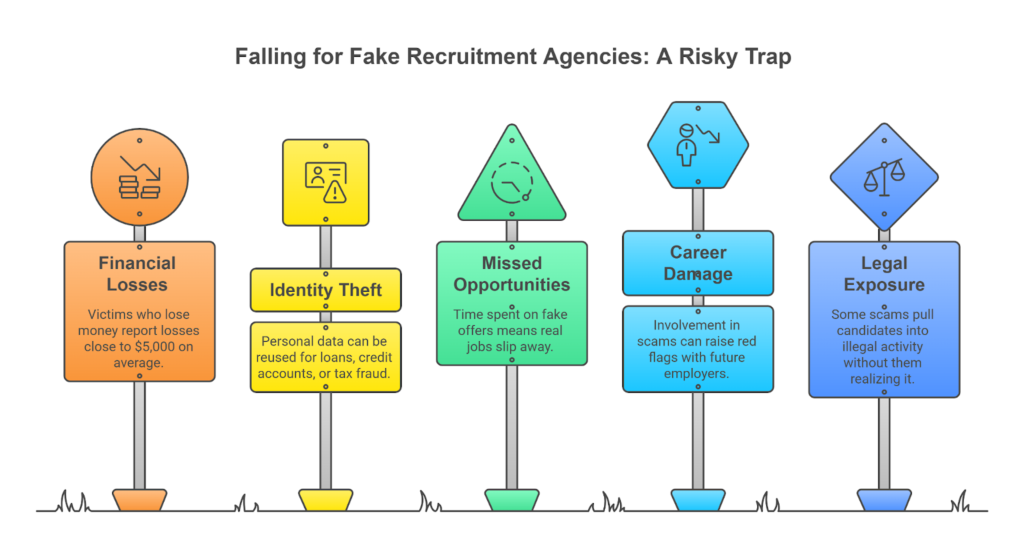
Financial losses
Not every scam asks for money up front. But when they do, the damage is real.
A study by BackOfficePro analyzed 3,845 job scam reports through April 2025, and found that only 14.3% involved direct financial loss. That sounds low until you look closer; when money was lost, the average hit was close to $5,000 per victim.
That’s rent and months of groceries. Once it’s gone, it’s rarely recovered.
Identity theft and data misuse
This is where things get more serious. Many fake recruitment agencies want your personal information. Social Security numbers, IDs, bank details, anything that can be reused or sold.
The FTC also reported over 1.1 million identity theft reports in 2024 alone. Once scammers have that data, they can open credit accounts, apply for loans, or file fraudulent tax returns in your name.
Long after the fake job disappears, the consequences stick around.
Missed legitimate opportunities
Time spent chasing a fake job is time you’re not spending on real ones.
Scammers drag candidates through interviews, assessments, and onboarding steps that feel legitimate. Weeks can pass before the truth comes out. By then, real opportunities may already be gone.
For job seekers in competitive markets, that delay can be costly.
Long-term career and reputational damage
Being linked to a scam can hurt more than your wallet.
Some fake recruitment agencies ask candidates to contact clients, handle packages, or interact with systems tied to illegal activity. Even unknowingly, that can create gaps, questions, or red flags later when you’re dealing with legitimate employers.
Legal and compliance exposure
In the worst cases, victims are pulled into illegal activity without realizing it.
Reshipping scams are a common example. There are no legitimate jobs that involve receiving packages at home and forwarding them elsewhere. Yet many candidates are convinced they’re working a real role until law enforcement gets involved.
That’s why the Better Business Bureau (BBB) warns job seekers to report these listings immediately and never share banking or identity information with anyone they haven’t verified.
Recent Examples of Recruitment Scams Around The World

These are real cases reported publicly in the last year. Let’s see how recruitment scams actually play out in practice:
1. LinkedIn job scams in the U.S.
In September 2025, Business Insider reported this case. Two U.S. job seekers thought they were applying for legitimate roles they found on LinkedIn. The postings looked real, recruiters had complete profiles, and the interview process felt normal.
Both ended up sending money. One lost $4,300. The other lost $15,000.
The scam worked because nothing felt rushed or sloppy. The fake recruiters used realistic timelines, professional language, and follow-ups that mirrored real hiring processes.
By the time doubts surfaced, the money was already gone.
2. TikTok recruitment scams in Kenya
In December 2025, The Guardian reported about fake agencies operating on TikTok, promising overseas jobs to thousands of people in Kenya. Agencies like WorldPath House of Travel claimed to have partnerships with international employers and offered help with visas and documentation.
Victims paid fees for paperwork, interviews, and placements that never existed. Some lost their life savings. Kenyan authorities eventually blacklisted more than 30 agencies and launched ongoing investigations.
3. Fake recruitment firm arrested in India
In India, Delhi Police arrested a man running a fake manpower recruitment firm tied to more than 85 cybercrime complaints. According to The Times of India, the operation collected payments from job seekers under the promise of placement, then laundered the money through multiple accounts.
The fraud only became visible after complaints piled up across regions.
How to Check if a Recruitment Agency Is Legit
You don’t need to be an investigator to verify a recruitment agency. What you must do is slow the process down and check a few basics that fake agencies usually can’t fake for long:
- Business registration and legal footprint. A legit agency is registered somewhere. That means a legal business name, physical address, and public records you can verify. If all you find is a website and a contact form, that’s not enough.
- Recruiter identity and professional history. Check who you’re actually talking to. Real recruiters have work histories, connections, and consistency across platforms. If the name, photo, or job history doesn’t line up, walk away.
- Online reputation and third-party signals. Look beyond testimonials on the agency’s website. Search the company name plus words like “scam” or “complaint.” Check BBB profiles, scam trackers, and independent reviews.
- Payment structure and recruitment process. Legitimate recruitment agencies don’t charge candidates for job placement. Ever. If money is required to move forward, that’s your cue to stop.
What to Do If You Suspect a Recruitment Scam
If something feels off, trust that instinct. Acting early makes a big difference:
- Stop communication and document everything: Don’t explain yourself. Don’t argue. Save emails, messages, job postings, and payment requests. That record matters if you need to report the scam.
- Secure personal and financial information: Change passwords. Monitor bank accounts and credit reports. If you’ve shared sensitive information, take action right away to limit further damage.
- Report the agency through proper channels: File reports with the FTC, the BBB Scam Tracker, and relevant job platforms. If the scam involved shipping or reshipping, report it to the U.S. Postal Inspection Service as well.
Don’t Let Recruitment Scams Get in the Way of Your Job Search
As you could see, recruitment scams are getting cleaner, faster, and harder to spot.
The good news is that most fake recruitment agencies follow the same patterns. Once you know what to look for, the power shifts back to you.
So, if you’re job hunting, take a few extra minutes to verify who you’re dealing with. If you’re hiring or working with recruiters, make sure your candidates know how to spot impostors using your brand. That extra step protects everyone involved.
At Estate Skyline, we work exclusively with real estate professionals and legitimate hiring partners. That means verified recruiters, transparent processes, and zero shortcuts.
If you’re unsure about a recruiter or want guidance on working with a legitimate recruitment partner, reach out. A quick conversation now can save you from a much bigger problem later.
FAQs
Are there known fake recruitment agencies to be aware of?
There is no official global list, but many fake recruitment agencies have been repeatedly reported through the BBB, FTC, and public complaints. This article includes several names based on consistent scam patterns.
How can I tell if a recruitment agency is legit or a scam?
Check business registration, recruiter identity, and payment structure. A legitimate agency will clearly explain who they recruit for, won’t charge candidates for placement, and can be verified through public records and third-party platforms.
What tactics do fake recruitment agencies commonly use?
They rely on urgency, vague job offers, unofficial communication channels, and requests for personal information or upfront payments. These tactics are designed to push you to act before verifying anything.
How do fake recruitment agencies affect job seekers and employers?
Job seekers face financial loss, identity theft, and missed opportunities. Employers and real agencies deal with impersonation, damaged trust, and confused candidates who no longer know who is legitimate.
What should I do if a fake recruitment agency scammed me?
Stop communication immediately, secure your personal and financial accounts, and report the incident to the FTC, BBB Scam Tracker, and relevant job platforms. Acting fast can limit the damage.


- TL;DR
- List of Reported Fake Recruitment Agencies in 2026
- What Is a Recruitment Scam?
- Why Recruitment Scams Are More Common Than Ever
- How Do You Spot a Fake Recruitment Agency?
- What Are the Risks of Falling for a Fake Recruitment Agency?
- Recent Examples of Recruitment Scams Around The World
- How to Check if a Recruitment Agency Is Legit
- What to Do If You Suspect a Recruitment Scam
- Don’t Let Recruitment Scams Get in the Way of Your Job Search
- FAQs